
2012 U.S. Dog Bite Fatality Statistics - DogsBite.org

Fatal Dog Attack Statistics
DogsBite.org recorded 38 fatal dog attacks in 2012.1 Citations of each victim's story are located on the Fatality Citations page. The last year the CDC recorded human deaths by dog breeds was 1998. Likely due to pressures from animal advocacy groups, the CDC stopped further research into this area. Since 1998, pit bulls alone have killed 208 U.S. citizens. The only other known entity, in addition to DogsBite.org, that tracks this vital data publicly is Animal People.

  • 38 U.S. fatal dog attacks occurred in 2012. Despite being regulated in Military Housing areas and over 600 U.S. cities, pit bulls contributed to 61% (23) of these deaths. Pit bulls make up less than 5% of the total U.S. dog population.2
  • Together, pit bulls (23) and rottweilers (3), the second most lethal dog breed, accounted for 68% of all fatal attacks in 2012. In the 8-year period from 2005 to 2012, this combination accounted for 73% (183) of the total recorded deaths (251).
  • The breakdown between pit bulls and rottweilers is substantial over this 8-year period. From 2005 to 2012, pit bulls
    killed 151 Americans, about one citizen every 19 days, versus rottweilers, which killed 32, about one citizen every 91 days.
  • See full report: 2012 U.S. Dog Bite Fatality Statistics - DogsBite.org
  • News release: Nonprofit Releases 2012 Dog Bite Fatality Statistics

Discussion Notes

2012 is the first year that DogsBite.org is adding a discussion section to our annual dog bite
fatality statistics. Annual data from 2012 shows a continuation of existing trends and new trends as well, some of which we will track in the future. To start, in the 8-year combined results, we see a whole number drop again in the average number of days, 19, that a pit bull kills an American, down from every 20 days in 2005 to 2011 results and 21 days in 2005 to 2010 results.

By reviewing the Fatal Pit Bull Attacks website, one sees that in the 8-year period from 1997 to 2004, pit bulls killed an American every 48 days. If one reaches back further into the 1980s, when the pit bull problem erupted on a national scale and cities began adopting pit bull laws, the spacing is even further. In the 8-year period from 1981 to 1988, a pit bull killed a person about every 65 days. This is generous, as the CDC study reflecting the same years shows every 70 days.

There is no dispute that pit bulls are killing at an accelerated pace. What is unknown is the "magic number" that must be reached -- a pit bull killing a person every 15, 10 or 5 days? -- before more lawmakers respond with measures to reduce these injuries and deaths. It is also unknown when more parents will reject the propaganda about this dog breed, spread by pit bull owners and animal welfare groups, and become aware of the injuries and deaths attributed to them.

That roughly one-third of all fatal dog attacks in 2012 occurred when the victim was either visiting or living temporarily with the dog's owner, and that 75% of the victims in these circumstances were children should send a powerful message to parents. There is an extremely heightened risk factor when a child is placed into these two scenarios, especially when the dog is a pit bull or rottweiler. In 2012, these two dog breeds accounted for 78% of the child deaths in these scenarios.

The death of a child by a so-called "service dog" also occurred under these circumstances. Last
January, a 6-year old boy and his family were visiting the home of a military serviceman
in Oak Grove, Kentucky whose dog was allegedly trained to help him cope with Post-Traumatic Stress Disorder. The dog horribly attacked the boy, killing him. There will be more "service dog" deaths, as the revised ADA fails to require certified training or licensing for a service dog.

In 2012, two "missing children" cases required multiple law enforcement agencies to carry out search and rescue missions. Kylar Johnson, 4-years old of Victoria, Texas was discovered dead 14 hours later, killed by a chained pit bull. Bryton Cason, 4-years old of Donalsonville, Georgia was discovered in his own front yard three hours later, killed by a loose dog. In the future, we might expect similar "missing children" search missions to be linked to a dangerous dog.

In 2012, two dog bite-related fatalities involved United States Postal Service employees. Dog bites and dog aggression have historically posed a problem for letter carriers, but the October attack on 55-year old Robert Rochester Jr., of New Castle, Delaware, further intensifies it. The dog in this instance escaped its owner's fenced property and viciously attacked Rochester who was collecting mail from a bin on a street, not making deliveries. Rochester died six days later.

In 2012, due to legal maneuverings by animal rights groups, two dogs that killed humans were spared euthanasia. On April 27, a Pennsylvania judge agreed to send a husky that killed a newborn to an out-of-state "sanctuary." The next case emerged on the same day, after a baby boy in Henderson, Nevada was killed by his grandmother's mastiff. The mastiff remains in quarantine awaiting a decision by the Nevada Supreme Court after intervention by the Lexus Project.

The circumstances and legal issues of the two cases differ, but the results are the same: the dog is sent to an out-of-state "sanctuary" to live out the rest of its life. Yet, after a dangerous dog is shipped across state lines, what oversight follows? In January, the Lexus Project gained ownership of a pit bull-type dog that was involved in a man's death. The group sent the dog, named Bones, to a residential home in Ohio that had 15 other dogs. Bones is currently missing.

Conclusion

The data from 2012 is painfully clear. Innocent people continue to be the suffers of the local and national battles waged by pit bull owners and animal advocacy groups, who have distorted the truth about pit bulls since the 1980s. Moreover, the government public health agency, the CDC, has abandoned the issue of dangerous dog breeds since their last published study in 2000, a study that had a 3-2 majority of animal authors, instead of medical doctors for human beings.

At that time, the CDC was led to believe by the animal authors that pit bulls had been replaced by a new killer breed, rottweilers, thus legislating specific dog breeds would be fruitless. Did the CDC doctors ever imagine back then that about a decade later an American would die every 19 days as the result of pit bull mauling? This is unknown, but the animal authors did know; each understood the unique attack behaviors of dogs selectively bred to fight to the death in a pit.3

If the public has to wait for the "magic number" to reach every 10 days, or worse every 5, to gain the attention of public health officials, the volume of serious and fatal maulings inflicted by well-documented dangerous dog breeds will be unspeakable.


Data Collection Method: How We Collect U.S. Dog Bite Fatality Data


1Mable McCallister died on December 31, 2011, but her death was not reported until January 3, 2012. Mable is included in the 2012 dog bite fatality statistical data and excluded from 2011. At least two additional victims died due to dog bite-related injuries in 2012. These deaths involved non-dog bite injury, minor dog bite injury or lacked a "reasonably clear" determination of death due to dog bite injury and are not included in the DogsBite.org statistical fatality data: Tim Thomas, 49-years old (Douglas County, GA) and Cary Phalen, 50-years old (Omaha, NE).
2More adoptions will not end shelter killing of pit bulls, by Merritt Clifton, Animal People, October 2011.
3While working at the Humane Society of the United States, Randall Lockwood participated in three dog bite fatality studies. Ironically, Lockwood's research of fighting dogs (the PDF file) was used to uphold the Denver pit bull ban.

Related articles:
07/24/14: Nonprofits Urge CDC to Resume Tracking Richer Data Set for Children and Adults...
2012 Dog Bite Fatality: Pack of Dogs Kills Boy in Cibola County, New Mexico

Navajo Nation boy killed by dogs
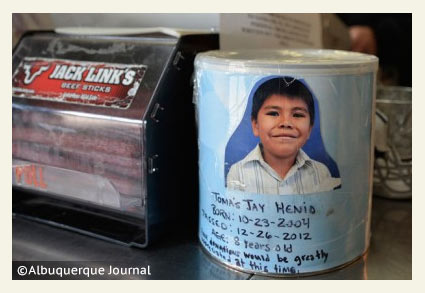
A donation can at the Pinehill market for Tomas Jay Henio.

Persistent Problem
UPDATE 12/31/12: The Albuquerque Journal spoke to family members of the young boy who died the day after Christmas after being mauled to death by up to nine dogs. Neither the boy's mother or stepfather heard screams or barks, which could have alerted them to the attack, they told the Journal. Tomas Jay Henio had spent the evening alone sledding down a snowy hill near his mother's home. The boy was already dead when his family members discovered him.

"We just don’t want to be around the house, with all the memories we have there," said the boy's stepfather, Keith Comosona.

Nine dogs, including one that weighed about 100 pounds, were quickly seized and euthanized by authorities. The dogs had been under the care of the child's great-uncle, a "dog lover," according to the Journal who had become a "collector over the years" taking care of dogs abandoned at the roadside near the base of the hill. Earlier this month, the same pack killed four goats. Other news reports say authorities will gather DNA samples to determine which of the dogs attacked.

The tone of the Journal article is one of despair and the persistency of the number of roaming dogs -- un-collared, unchecked, abandoned, stray, feral or otherwise -- within Navajo Nation. DogsBite.org grieves for the young boy's family and the whole Pinehill community.

12/29/31: Insights from Behaviorist
In response to the "wild dogs" or "feral dogs" confusion brought to light by the death of 8-year old Tomas Jay Henio in Cibola County, New Mexico1 DogsBite.org reaches out to animal behaviorist Alexandra Semyonova for a better understanding. As suspected, even the term "feral dogs" cannot be used as loosely as the Cibola Beacon did, and there is a significant difference between "feral" and "stray" dogs, the former having never been kept or owned by a human.2

Alexandra Semyonova

When ethologists go out to watch free-ranging dogs, they generally define in each published article what they'll mean by 'feral', 'stray', 'free-ranging'. 'Stray' usually means owned dogs that are either roaming or have been abandoned. These are dogs that were born of dogs kept by humans, in a home or on some kind of yard or farm terrain. They've had some kind of contact with humans in a living situation, were kept and fed until they roamed, got lost, or got dumped somewhere. 'Feral' usually means domestic dogs born to these roaming dogs outside of any human care or contact. A 'feral dog can be first generation, second, etc -- but in any case a feral dog was never kept or owned by a human. You can't tell by looking at a dog whether it ever lived in a human home, so many ethologists just talk about 'free-ranging' dogs. This means any dog that's travelling and/or living without human supervision, regardless of its origins or past.

'Wild' and 'feral' do not mean the same thing. A wild animal is an individual of a species that has never been domesticated. A feral animal is one of a domesticated species that was somehow born outside of human care and is living a life as best it can in a niche without human help. Its offspring are also 'feral' -- not wild, but a domesticated species born and living in non-domestic circumstances.

When we talk about the domestic dog, the distinction between 'stray' and 'feral' is relevant. A free-ranging stray won't behave the same as a free-ranging feral dog. A stray will more easily make contact with a human, in a good or bad way depending on its experience with humans. A feral dog will be extremely shy of humans, as dogs tend to be of anything they weren't exposed to in the first six months of their lives. Then there are the dogs that occupy a middle ground -- third world village dogs, dump dogs, the dogs that roam the streets of cities in places like Greece and Turkey. Even if they weren't born under human care, they grow up in close proximity to humans (human city dwellers, human dump dwellers). Generally the relationship is peaceful unless a dog is cornered and feels it has to fight for its life. Domestic dogs have lived with humans this way for at least ten millennia without often harming our children, our cattle or us.

This is changing in places where the weapon dog fashion has come into sway. The Coppingers describe a trash dump in Tijuana Mexico, where there were roaming Rottweilers and clear pit bull type dogs. They say that these dogs often wore collars, were clearly owned or had been owned -- and that these dogs behaved differently from other free-ranging or dump dogs. They were more aggressive. Rather than shyly avoiding humans, these Rott / pit types were willing to pursue humans in a threatening way. For the first time in all their travels, the Coppingers felt a bit afraid of 'free-ranging' dogs. [Dogs: A Startling New Understanding of Canine Origin, Behavior & Evolution, 2001, pages 322 - 323.] This is a new problem in many third world countries, where affluent people are getting fashion weapon dogs, but then letting them roam as if they were indigenous free-ranging dogs. This has led to vicious and/or fatal attacks by 'free-ranging' dogs becoming much more common than they have been in 12,000 years.

It will be interesting to see whether police release photographs of these 'wild' or perhaps only 'feral' dogs, one of which was clearly neither wild nor feral, but a roaming owned dog. If they don't, then there is good reason to suspect that they are covering up a different issue that's becoming urgent all over the world as the weapon dog proliferates among us. Up to now, the pit bull lobby has mostly maligned first world owned breeds in their attempts to protect the pit bull. Golden Retrievers bite the most, Chihuahuas are more aggressive, and so on. This is sad. But it would be even sadder if the feral domestic dog, which lives and survives under mostly sad circumstances but has nevertheless rarely hurt us, becomes the next target in the attempt to deflect blame from the real culprit -- the weapon dog. This farce has already led to efforts to eradicate peaceful ordinary free-ranging dogs in places like India and Greece. If anyone reading this really loves dogs, they will want to see photographs of the dogs that attacked this child. They will want to be sure that the indigenous Navajo dogs aren't being blamed for something a load of imported, roaming weapon dogs did.

Alexandra Semyonova is an internationally acclaimed animal behaviorist and author of The 100 Silliest Things People Say About Dogs. Academically educated in behavioral science and specialized in animal behavior, she provided a major breakthrough for the field in her paper, The Social Organization of the Domestic Dog. She has worked with dogs and their owners on a daily basis for more than 30 years. Visit her website at Nonlinear Dogs. View additional DogsBite.org posts that Semyonova has provided commentary for in the past.


12/28/12: Child Killed by Dogs
Cibola County, NM - In a developing story, an 8-year old boy was mauled to death by a pack of dogs Wednesday in the Pinehill area of Cibola County. Ramah Navajo Police Department Sgt. Delvin Maria, who verified that the attack occurred, said that one of the nine dogs that attacked the boy belonged to the owners of the home the boy was from. Few other details have been released. The case is still under investigation and the Gallup FBI office has taken over the case.

It is important to point out that "wild dogs" or "feral dogs," as alleged by the Cibola Beacon news group, are more commonly roaming dogs with owners or dogs that have been abandoned by their owners and left to fend for themselves. As Sgt. Delvin Maria verified, at least one of the attacking dogs belonged to the home the boy was from. A true wild dog is categorized as a separate species than the domesticated dog, such as the African painted dog3 and Indian wild dog.4

map iconView the DogsBite.org Google Map: Fatal Dog Attacks on American Indian Reservations.

Learn about breed-specific laws on Indian reservations in our Breed Safety Laws section.

1In 2010, in the adjacent county of McKinley, 55-year old Larry Armstrong was killed by an alleged pack of "wild dogs" that turned out to be roaming dogs with an owner.
2The Atlanta Journal-Constitution adopted the term "mongrel dogs" after the double canine homicide of Lothar and Sherry Shweder in 2009, despite the fact that some purebred dogs were among the pack.
3In November, a young child fell from a viewing platform at the Pittsburgh zoo into an African painted dog exhibit. He was immediately killed by the dogs. The observation platform is set to be removed, according to officials.
4Feral dogs are a problem in U.S. jurisdictions. But again, this is often the result of owner abandonment; this type of dog should not be confused with a "wild dog" species. Fatal dog attacks by "feral" dogs are rare in the U.S.

Related articles: 
03/30/11: 2011 Dog Bite Fatality: 55-Year Old Man Killed by Pack of Dogs Near Gallup
08/19/09: 2009 Fatality: Senior Couple Killed by Pack of Dogs in Oglethorpe County
08/15/09: 2009 Fatality: Winterhaven Man Killed by Pack of Dogs

Photo: ABQJournal.com

Solesky Family Releases 911 Call at the Center of High Court Decision, Tracey v. Solesky

The 911 call portrays a life-threatening attack upon a young boy by a neighbor's pit bull.

Towson, MD December 17, 2012 -- Anthony and Irene Solesky, the parents of a young pit bull mauling victim at the center of Tracey v. Solesky, an appellate court decision that declared pit bulls "inherently dangerous," release the 911 call of the attack upon their son. The life-threatening attack inflicted by a neighbor's pit bull occurred in a residential alley on April 28, 2007 at approximately 5:22 pm. The YouTube video portraying the 911 call is just over nine minutes long.

911 Call of Tracey v. Solesky - Pit Bull Attacks Maryland Boy

Back in August, during a Special Session, the Maryland legislature attempted to diminish the high court's decision by advancing an emergency bill. The effort did not succeed. On January 9, the General Assembly meets for the 2013 Session and is expected to again introduce legislation that will reduce the appellate court's decision. Prior to doing so, Anthony Solesky urges legislators to listen to the 911 call and to resolve that this never happens again in the New Year.

See: Full news release  |  Maryland Dog Bite Victim Advocacy  |  Follow: @Supportthecourt


This video was created and edited by DogsBite.org, a national dog bite victims' group dedicated to reducing serious dog attacks. Our Texas-based nonprofit submitted an amicus brief on behalf of the young pit bull mauling victim. The highest court in Maryland agreed with our brief.

Related articles:
08/21/12: Maryland Court of Appeals Narrows Decision to Pit Bulls; Removes Cross-Bred Pit Bulls
08/15/12: Anthony Solesky, Father of Pit Bull Mauling Victim, to Testify at Hearings
06/18/12: Maryland Pit Bull Task Force Forum Live Tweeting June 19th @Supportthecourt
06/08/12: DogsBite.org Launches Maryland Dog Bite Victim Advocacy Web Page
04/30/12: Maryland Court of Appeals Holds Pit Bull Owners and Landlords Accountable
01/16/12: Pit Bull Attack Victims May Have New Hope to Recover from Landlords
03/10/10: Dangerous By Default: Extreme Breeds by Anthony Solesky

2012 Dog Bite Fatality: Rescue Pit Bull Kills 2-Year Old Girl; Nearby Restrictions Lifted in 2010

rescue pit bull kills topeka child
Savannah Edwards, 2-years old, was killed by a rescue pit bull near Topeka.

Past Law Clarification
UPDATE 12/16/12: A Sunday article by the Topeka Capital-Journal clarifies the history of Shawnee County. The county has never had a breed-specific ordinance, though the City of Topeka, which is the county seat of Shawnee County, once did. Topeka repealed the ordinance in 2010 and now boasts a "behavior-based" ordinance rather than a "breed-based" one. Savannah Edwards was killed by a "rescue" pit bull in Shawnee County, outside of Topeka city proper.

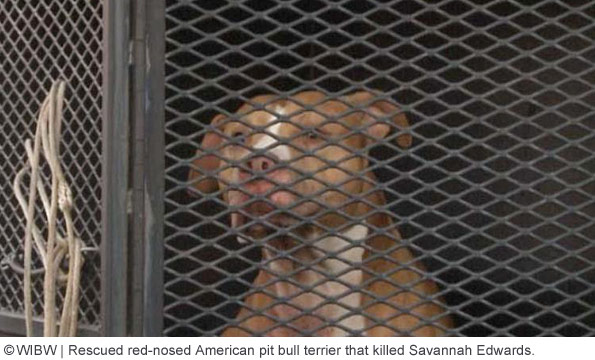
The child was visiting a relative with her mother on Thursday at a home on Cross Street when a rescue pit bull belonging to a tenant of the residence attacked. Savannah was rushed to a hospital in Topeka, but did not survive. There is still no information about how long the pit bull had lived at the residence or what shelter it came from. The family has requested the media not contact them. As of Sunday, the Shawnee County Sheriff's Office also has not released this information.

12/14/12: Dog-Aggressive "Rescue"
WIBW.com shows footage of the red-nosed rescue pit bull being directed into the county animal control vehicle and interviews several neighbors. Ruth Courville, who is new to the neighborhood, told the news group she had only seen the dog one time and it appeared amicable. Neighbor's who did not want to appear on camera, however, told WIBW that the owner warned them that his "rescue" pit bull was dog-aggressive and that it would attack other dogs if given the chance.

Exactly in what neighborhood is a dog-aggressive pit bull -- "would attack other dogs if given the chance" -- appropriate? Your neighborhood? Your mother's neighborhood? The shelter or rescue that adopted out this dog-aggressive pit bull has still not been named, but it hardly matters given that there are hundreds of these entities across the U.S. that do the same thing everyday. Such groups have "zero" concern about the dangerousness these dogs pose to neighborhoods.

In this case, the "neighborhood suitable" dog-aggressive pit bull was also human-aggressive and struck down the life of an innocent young child.

It's bad enough to place a neighborhood's beloved pets at risk with these types of dogs, which by default also places their owners at risk who will and do receive serious and sometimes fatal injuries trying to save their pet when under attack. This risk shoots off the charts when it comes to dog-aggressive pit bulls, a breed of dog already artificially engineered through selective breeding for explosive dog aggression for the sole purpose of attacking and killing dogs in a fighting pit.

After publishing this post Friday night, the WIBW news story was updated to include the identification of the victim. Savannah Edwards, 2-years old of Topeka, Kansas is the 207th American killed by a pit bull since the CDC stopped tracking deaths by dog breeds in 1998.


12/14/12: Pit Bull Kills Child
Topeka, KS - A 2-year old girl who was attacked by a pit bull on Thursday has died from her injuries. Earlier reports said the child was airlifted to a Topeka hospital with life threatening injuries. The little girl and her mother were visiting a tenant when the tenant's dog suddenly attacked the girl. The tenant is related to the child's mother. Authorities said the dog is a 6-year old male "pit bull-mix."1 The dog was adopted from a shelter, according to one official on the scene.

In September 2010, Topeka repealed its pit bull ordinance in a 9-0 vote2 -- a vote that included current Mayor Bill Bunten. The previous ordinance declared pit bulls "dangerous" and required owners to adhere to special licensing, leashing, confinement, microchipping and insurance requirements. (See: Sections 18-153 through 18-179 of the ordinance). Our guess is, a landlord while under the previous ordinance would not have allowed a "tenant" to harbor a pit bull.3

rescue pit bull kills girl in shawnee county, near topeka

1Calling this red-nosed pit bull terrier a "pit bull-mix" is totally inaccurate.
2Included in the repeal was a "loosening up" of how shelters adopt out pit bulls picked up by the city.
3We learned Friday (12/14) that although the address of the dog owner, 5831 SE Cross St, lies in Topeka, this area is under the jurisdiction of Shawnee County, not the City of Topeka.

Related articles:
10/04/12: 2012 Dog Bite Fatality: Pembroke 'Dog Rescuer' Killed by Own Dogs
08/17/12: 2012 Dog Bite Fatality: 23-Year Old 'Dog Rescuer' Mauled to Death by Own Dogs
04/06/12: Week of Escalating Violent Attacks by Rescued and Adopted Pit Bulls