



Special Report: Dog Biting Incidents (2014 to Present)
German shepherd: Gomagoti, CC-BY-SA 2.5 and Labrador: IDS.photos, CC BY-SA 2.0
DogsBite.org - From January 2014 to present, animal control and health departments in 20 U.S. states report that pit bulls lead all dog breeds in biting incidents, including: Arizona, California, Colorado, Florida, Iowa, Kansas, Kentucky, Massachusetts, Michigan, Mississippi, Missouri, New York, Ohio, Oregon, Pennsylvania, Rhode Island, South Carolina, Texas, Washington, Wisconsin and Wyoming. in addition to dominating biting incidents, the pit bull bite is also the most damaging, according to scientific medical studies. Also see: Archived Dog Biting Incidents (2005 to 2013)
New York City, New York
In December 2025, we released a report analyzing 29,992 self-reported dog bites collected by the New York City Department of Health from 2015 to 2023, a period before and after the pandemic. Post-Covid bite incidents increased 14% from 2018, primarily driven by a near-doubling (97%) of bites attributed to dogs of “unknown” breed since 2020, obscuring key data trends. This is a phenomenon that emerged after two key city policy changes. Despite this, pit bulls remain overrepresented, accounting for 30.4% of attacks when breed is known (76% of cases). Borough-level data showed that Staten Island had the highest bite injury rate per 100,000 population (56.89) during the period.
DogsBite.org adapted datasets: Top‑Biting Breeds Pre‑ and Post‑Covid - New York City (2018 vs. 2023); Dog Bites by Breed, Gender and Reproductive Status - New York City (2015–2023); Dog Bite Injury Rate by Borough, Breed and Year - New York City (2015–2023); Dog Licensing vs. Bite Data After New York City Policy Changes (2015–2023)
Austin, Texas | Severity Data
In May 2025, we released a report analyzing 12 years of dog bite severity data, a period before and after the Covid-19 lockdowns, in the city of Austin. Between 2018 to 2023, severe injury bites inflicted by dogs nearly tripled, from 45 bites to 132. In the same period, severe injury bites inflicted by pit bulls rose 533%. In 2023, pit bulls inflicted 76 severe bites, over 9 times more than any other breed. The sharp rise in severe bites coincides with Austin adopting two no-kill polices in 2019, including a "Right to Rescue" ordinance, which resulted in 352 dogs with a modest or severe bite history recycled back into the community, and a "95% save rate" mandate, beyond the arbitrary 90% "no-kill" save rate.
Top-Biting Dog Breeds by Year and Injury Severity (2012-2023) (PDF), Austin Animal Center, DogsBite.org.
San Bernardino County, California | Severity Data
In November 2024, we analyzed eight years of dog bite injury severity data (2016-2023) from San Bernardino County Animal Services. A total of 5566 bites were reported during the period. From 2016 to 2023, the total number of bites increased 27% (695 to 883). Among the different severity levels, bites of minor severity increased 13% (373 to 420); bites of moderate severity increased 38% (218 to 300), and bites of severe injury increased 70% (61 to 104). Severe injury bites increased over 5 times more percentage-wise than minor injury bites and over 1.75 times more than moderate injury bites. Pit bulls inflicted 40% (297/736) of all severe injury bites, nearly 4 times more than any other dog breed.
San Bernardino County, California | Severity Data
Also in 2024, we analyzed three years of Covid dog bite data (2020-2022) from San Bernardino County Animal Services. In 2020, 602 bites were reported. Pit bulls led bites in all three injury severity categories (Minor, Moderate and Severe), inflicting 182 bites, over 3 times more than any other breed. Of the bites categorized as "Severe," pit bulls inflicted 41% (40/98). In 2021, 592 bites were reported. Pit bulls led bites on all injury levels, inflicting 158 bites. Of the bites categorized as "Severe," pit bulls inflicted 37% (39/106). In 2022, 717 bites were reported. Pit bulls led bites on all injury levels, inflicting 190 bites. Of the bites categorized as "Severe," pit bulls inflicted 50%. (56/112).
2021 DogsBite.org adapted dataset (PDF) | 2021 Raw dataset of all dog bites (PDF)
2022 DogsBite.org adapted dataset (PDF) | 2022 Raw dataset of all dog bites (PDF)
Louisville, Kentucky
In an April 2024 special report, we published our analysis of Louisville Metro Animal Services (LMAS) dog bite investigations, other public safety activity types, and dog licensing trends by breed during the 4-year period of 2020 to 2023. Despite only comprising 9.8% of licensed dogs, pit bulls accounted for 46% of dog bite investigations, 5 times higher than the next closest breed. Pit bulls accounted 47% of dog-on-dog attack investigations, nearly 6 times higher than the next closest breed, 46% of illegal dog chaining investigations, and more. Of the 11 public safety activity types we examined in the LMAS open data set, pit bulls consumed over 5 times more animal control resources than the next closest breed.
San Antonio, Texas | Severity Data
In October 2023, after Ramon Najera Jr. and Paul Striegl were killed in separate attacks by pit bulls, a local news agency reviewed dog bite statistics from San Antonio Animal Care Services (SAACS). Of the 411 dog bites that resulted in hospitalization or death during the fiscal year of 2023, 331 had a breed recorded in the SAACS database. Pit bulls were responsible for 31% of these hospitalizations when breed was known (101 of 331) and 25% of all cases (101 of 411). Pit bulls were responsible for both fatalities that occurred in the same period. Our 2019 review of SAACS dog biting incidents shows the city agency categorizes "pit bulls" into four separate breed names to muddy the waters.
DogsBite.org adapted dataset (PDF) | Related 2017: DogsBite.org adapted dataset (PDF)
Woodbury County, Iowa
In March 2023, we analyzed dog biting incidents collected by the Siouxland District Health Department over the period of January 1, 2018 to December 31, 2022. On November 25, 2019, Sioux City repealed its longstanding pit bull ban. During 2019, there were only 5 pit bull bites. By the end of 2020, pit bulls became the top-biting breed with 18 biting incidents, leading Labrador retrievers (14 bites) and German shepherds (14 bites). By the end of 2022, bites inflicted by pit bulls rose to 27, an increase of over 5 times since 2019. Pit bulls now maintain over a 2:1 margin lead in bites inflicted by Labrador retrievers (12 bites) and a 3:1 margin lead in bites inflicted by German shepherds (9 bites).
Allegheny County, Pennsylvania | Licensing Data
In December 2022, the Allegheny County Health Department released dog biting incidents for 2021. A total of 1,710 dog bites were reported. Dog breeds and licensing records were also released. Pit bulls inflicted the highest frequency of bites 14.3% (244) but only comprised 3.2% of the licensed dog population, a significant overrepresentation of bites compared to county license data. Multiple other breeds also had a disproportionate number of bites compared to county license data, including: German shepherd with 5.1% (88) of bites and 3% of licensing data; bulldog with 3% (51) of bites and 0.2% of licensing data; and husky, with 1.8% (31) of bites and 1% of licensing data (View chart)
New York City, New York
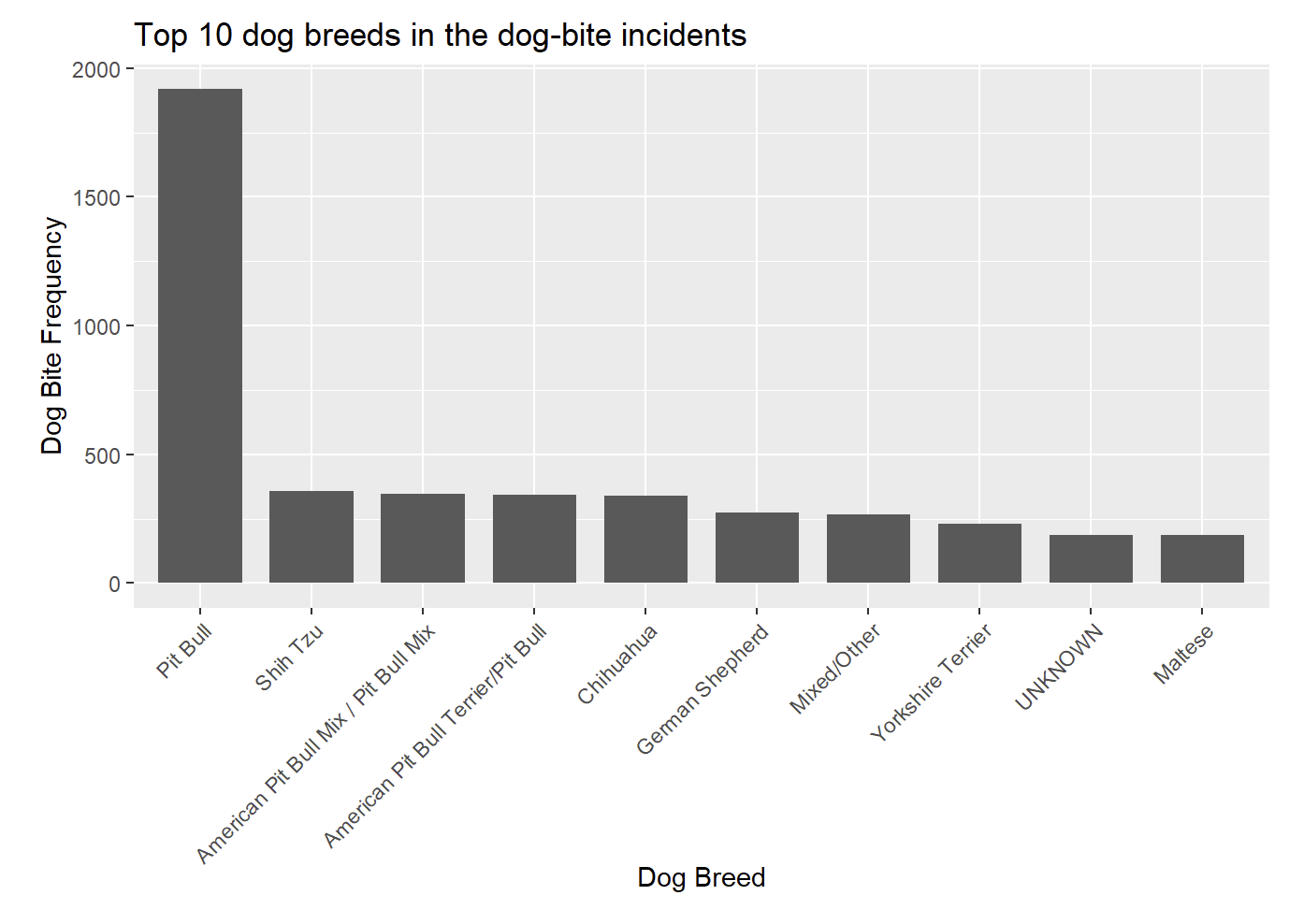
In May 2022, we analyzed the self-reported dog biting incidents collected by the New York City Department of Health over the period of January 1, 2015 to December 31, 2021. There were 22663 dog bites reported in the 7-year period; breed was known in 79% of cases (17992). Pit bull bites (5533) exceeded the next top biting purebred, shih tzu (888), by over 6 times. The "mixed-breed" group weighed in at 1659. When gender was known, male dogs accounted for 72% of all bites. Comparing data sets, 2015-2017 and 2018-2021, shows that bites reported as "mixed-breeds" increased 220% between the two periods. No other top-biting breed had this significant rise.
City and County of Denver, Colorado | Severity Data
In January 2022, Axios published 2021 dog bite data for Denver. A total of 695 dog bites were recorded. In November 2020, voters repealed the city's pit bull ban. Just one year after rescinding the ban, pit bulls became the top-biting breed with 117 bites (17% of total, 117/695), nearly twice as many as the next top-biting breed, German shepherds, 61 bites. Prior to the ban being rescinded, our nonprofit examined three years of Denver dog bite data (2017-2019). Pit bulls inflicted 41 bites in 2017 (6% of total), 34 bites in 2018 (7% of total), and 38 bites in 2019 (7% of total). Thus, between 2020 and 2021, which includes a year before and after the ban was lifted, pit bull bites tripled in Denver.
Addendum - Denver Top-Biting Breeds by Bite Level and Denver Top-Biting Breeds by Year, January 1, 2017 to December 31, 2019, DogsBite.org, May 30, 2024 (dogsbite.org) | DogsBite.org adapted dataset (PDF)
Dog Bites on Humans and Injury Severity Level, January 1, 2017 to December 31, 2019, Denver Animal Shelter | DogsBite.org adapted dataset (PDF) | Raw dataset of all top biting breeds (PDF)
State of South Carolina
In April 2021, the South Carolina Department of Health and Environmental Control released state-level dog bite data. This is a rare occurrence that we have only seen in one other state, Delaware (2011). The data showed that during 2019 there were 7,499 recorded dog bites when breed was known. Of those, one-third, 2,433 bites, were attributed to pit bulls and their mixes, three times more than the next top-biting breed, Labradors and their mixes with 833 bites. The data was released in conjunction with House Bill 4094, filed by Rep. Chip Huggins. The bill requires the registration of all "fertile pit bulls" and a $25 dollar fee, which is $475 lower than a similar bill introduced in 2019.
Kansas City, Missouri
Also in April, our nonprofit obtained dog bite data from the Kansas City Animal Health and Public Safety Division. We now have three consecutive years of dog bite data from the city: 2018, 2019 and 2020. The most recent data, 2020, shows the continuing staggering trend of pit bulls disproportionately biting. From January 1 to November 30, 2020, there were a total of 373 dog bites reported. Pit bulls inflicted 195 of of these bites, 52%. Pit bulls inflicted over five times more bites than the next closest breed, Labrador retrievers, with 34 bites. The 2020 results are even worse than 2019, when pit bulls inflicted 46% of bites, over four times more than any other dog breed.
UK and Netherlands
In March 2021, we examined two recent peer-reviewed studies (2020 and 2019) that investigated dog-on-dog attacks and “dog-killing" aggression in the UK and Netherlands, a field of study that otherwise has a glaring absence of data, especially in the United States. In the UK study, pit bull breeds inflicted these attacks 5 times more frequently than other breeds (75 of 188; 40%). In the Netherlands study, pit bull breeds inflicted these attacks 3.75 times more frequently than other breeds (71 of 128; 56%). Both peer-reviewed studies also showed that small dog breeds, such as Yorkshire terriers and chihuahuas, made up the vast majority of victimized dogs, 70% and 83% respectively.
Dog Bites Dog: The Use of News Media Articles to Investigate Dog-on-Dog Aggression, by Montrose VA, Squibb K, Hazel S, Kogan LR and Oxley JA, Journal of Veterinary Behavior , 40 (2020) 7e15.
Intraspecific Killing in Dogs: Predation Behavior or Aggression? A Study of Aggressors, Victims, Possible Causes, and Motivations, by Schilder, MB, van der Borg, JA, Vinke, CM, J Vet Behav, 34 (2019) 52e59.
Allegheny County, Pennsylvania | Licensing Data
In September 2021, the Allegheny County Health Department released dog biting incidents for 2020. A total of 1,685 dog bites were reported. Dog breeds and licensing records were also released. Pit bulls inflicted the highest frequency of bites 13.9% (234) but only comprised 4.1% of the licensed dog population, a significant overrepresentation of bites compared to county license data. German shepherds followed, inflicting 5.9% (99) of bites and comprised 5.2% of licensed dog data, a balanced representation between bites and licensing data. Several other breeds, including husky, Labradoodle and mastiff, also had a disproportionate number of bites compared to licensing data. (View chart)
Aurora, Colorado
In June 2020, we obtained 3-years of dog bite statistical data by breed from the city of Aurora. Our records request came after the city began discussing a repeal of its pit bull ban that it adopted in 2005. From January 1, 2017 to December 31, 2019, there were 1180 total bites to humans. Among the top-biting breeds, the "Pit bull (restricted)" group nearly tied for second place, inflicting 104 bites. This breed group followed Labrador retrievers (121 bites) and German shepherds (105 bites). When combined into the "Pit bull (all)" group, which includes pit bulls and their mixes that do not meet the definition in the ordinance, pit bulls catapulted to the lead with 151 bites.
Harris County, Texas | Severity Data
In March 2020, a large-scale study was published in Veterinary World, "A look at the incidence and risk factors for dog bites in unincorporated Harris County, Texas, USA." Between 2013 and 2016, 6683 bites were reported. Pit bulls had the highest frequency of bites (25.07%), followed by Labrador retrievers (13.72%). In bites recorded as "severe" or "mauling," pit bulls also had the most biting incidents (49.57%); nearly four times higher than the next closest breed, Labrador retrievers (12.92%). "The odds of a severe injury by a pit bull is 213% higher than the odds for dogs of all other breeds (excluding German Shepherd and Labrador Retriever)," states the study.
A look at the incidence and risk factors for dog bites in unincorporated Harris County, Texas, USA, by Hasoon B, Shipp A, and Hasoon J, Vet World, 2020 Mar; 13(3): 419–425.
Vancouver, British Columbia
In February 2020, we received dog bite statistical data from a Canadian citizen who obtained data from the city of Vancouver, British Columbia. The city provided dog bites by breed type from January 1, 2016 to December 31, 2018. Pit bulls inflicted more attacks on humans and animals than all other dogs when breed was known. Over the 3-year period, there were 432 attacks on humans. Pit bulls inflicted 12% (51) of these bites. German shepherds followed with 34 bites. During this same period there were 344 attacks on animals. Pit bulls inflicted 26% (90) of these attacks, over three times more than the next closest breed, German shepherds with 29 bites.
City and County of Denver, Colorado | Severity Data
Also in February, we obtained dog bite statistical data by breed and injury severity from Denver Animal Shelter over a 3-year period. Our records request came after an attempt to repeal the 30 year old pit bull ban failed, halted by a veto from the mayor. From January 1, 2017 to December 31, 2019, there were 1717 total bites to humans. Bites were separated into four levels of severity, 2 to 5, with 5 being the most severe. Of the combined categories of the most severe bites, Levels 4 and 5, there were 168 bites among the top biting breeds. American bulldogs inflicted the most serious bites, 17% (29), followed by Labrador retrievers, 16% (27) and pit bulls, 14% (24).
Kansas City, Missouri
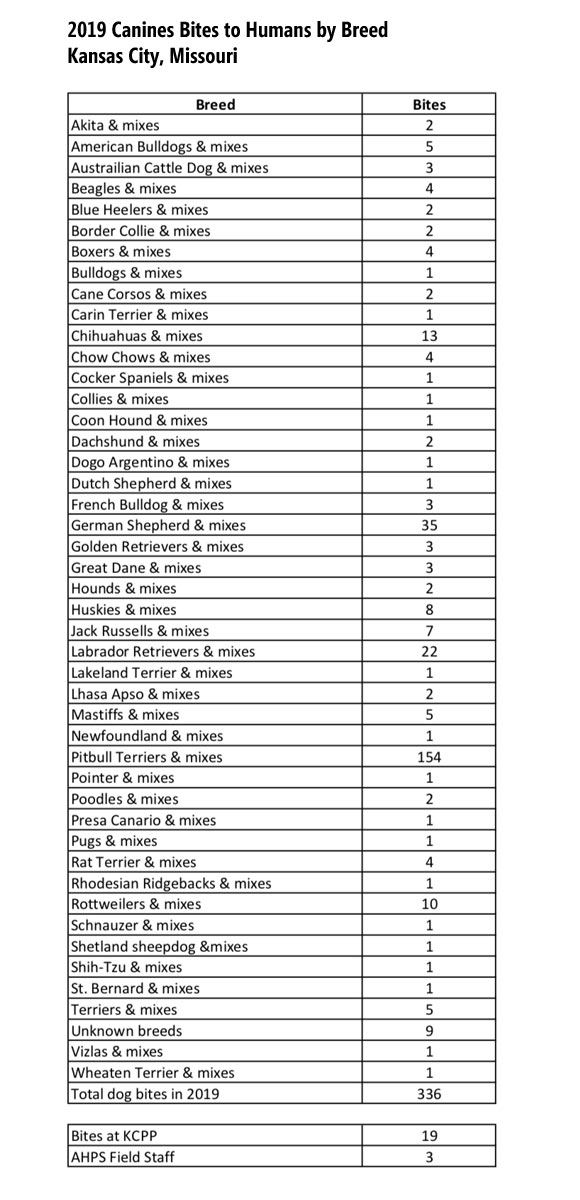
Also in February, we obtained two years of bite data from Kansas City, Missouri. In 2019, there were a total of 336 canine bites to humans. Pit bulls and their mixes inflicted 46% (154) of all bites, over four times more than any other breed. German shepherds and their mixes followed, inflicting 10% (35). 6.5% of all bites (22 of 336) occurred at the shelter or involved field staff. In 2018, there were a total of 343 canine bites to humans. Pit bulls and their mixes inflicted 49% (168) of all bites, over five times more than any other breed. German shepherds and their mixed followed, inflicting 9% (32). Only 2% of all bites (7 of 343) occurred at the shelter or involved field staff.
Maricopa County, Arizona
Also in February, 12 News I-Team examined how the high unwanted pit bull population is "overwhelming shelters" and contributing to attacks. The investigative news agency examined dog bite records from Maricopa County Animal Care and Control and found that pit bulls contribute to hundreds of more biting incidents compared with other dog breeds. From January 1, 2019 to December 31, 2019, there were over 4,700 bites to humans and animals. Pit bulls and their mixes inflicted 801 of these bites, 17% of total. This is over twice the number of bites inflicted by the next closest breed, German shepherds and their mixes, which inflicted 344 bites, 7% of total.
Pawtucket, Rhode Island
In October 2019, The Valley Breeze obtained records of dog bites in Pawtucket since the city was forced to lift their longstanding pit bull ban in 2013. Back in September 2013, we did an extensive report on the success of Pawtucket's pit bull ban. Attacks inflicted by pit bulls plunged into scarcity during 10-year ban period of 2004 to 2013, when only 23 bites were attributed to the breed. Over the recent 5-year period of July 1, 2014 to September 30, 2019 there were a total of 319 dog bites and attacks on people and other animals. 116 were attributed to pit bulls or pit bull mixes, 36%. Today, there are 10 times as many attacks per year by pit bulls than during the ban years.
"Dramatic Decline in Attacks by Pit Bulls Since Pawtucket Adopted Pit Bull Ban in 2004," DogsBite.org, September 17, 2013 (dogsbite.org) | DogsBite.org adapted dataset (PDF)
Fairfield, Ohio
In September 2019, the city of Fairfield released dog bite statistical data while discussing a proposed ordinance that repeals the city's longstanding pit bull ban. Between 2016 and present, a total of 59 biting incidents were reported. Pit bulls were responsible for 14 of these biting incidents, 24%. Fairfield enacted its pit bull ban in 2006, yet a quarter of the recently reported dog bites still involved pit bulls. The proposed ordinance requires all dog owners to maintain $10,000 in dog bite liability insurance. Also, the penalty for a first offense of a dog "running at large" violation under the proposed ordinance is a fourth degree misdemeanor: a fine up to $250 and up to 30 days in jail.
Woonsocket, Rhode Island
Also in September, The Valley Breeze obtained dog bite statistical data from the Woonsocket Police Department. The data shows that 171 dog bite incidents have been reported since 2014. Of these, 42% (72) were inflicted by pit bulls or pit bull-type breeds. This is 12 times more than the next closest breeds: shih tzus and chihuahuas, each with 6 biting incidents. German shepherds and Labrador retrievers followed, each with 5 bites; poodles, rottweilers and boxers, each with 3 bites; and huskies and bulldogs, each with 2 bites. Bites to both people and animals are included in the incidents. 10 incidents involved dogs biting police officers, mailmen or state constables.
Kansas City, Missouri
In March 2019, we obtained animal quarantine bite data from the city of Kansas City, Missouri. From January 1, 2018 to December 31, 2018, there were 270 total animals held in bite quarantine after inflicting a bite. Dogs were responsible for 242 of these bites. Pit bulls and their mixes inflicted 46% (111) of all dog bites requiring quarantine, nearly six times more than any other breed. Labradors and their mixes followed, inflicting 8% (19) of dog bites requiring quarantine. Shepherds, a broad category excluding German shepherds, followed with 14 bites and German shepherds with 11 bites. No other dog breeds held in quarantine inflicted more than 10 bites.
San Bernardino County, California | Severity Data
In February 2019, San Bernardino County Animal Services released dog bite statistical data after four pit bulls killed Lana Bergman. During the 12 month period of 2018, there were 648 dog bites. Pit bulls led biting incidents in three injury severity categories: Minor (63), Moderate (75) and Severe bites (24), inflicting a total of 167 bites. German shepherds followed with 100 bites. Of the total number of bites categorized as "Severe," pit bulls inflicted 25%, followed by German shepherds with 15%. In the gender categories, unsterilized male dogs inflicted 26% of all bites, followed by neutered males, 25%, unsterilized female dogs, 21%, and spayed females, 16%.
URL:https://www.kesq.com/news/mauled-new-questions-surround-the-death-of-a-desert-woman-attacked-by-four-pit-bulls/1007053873. Accessed: 2019-03-13. (Archived by WebCite® at https://www.webcitation.org/76quUTss8)
DogsBite.org adapted dataset (PDF) | Raw dataset of all dog bites (PDF)
New York City, New York
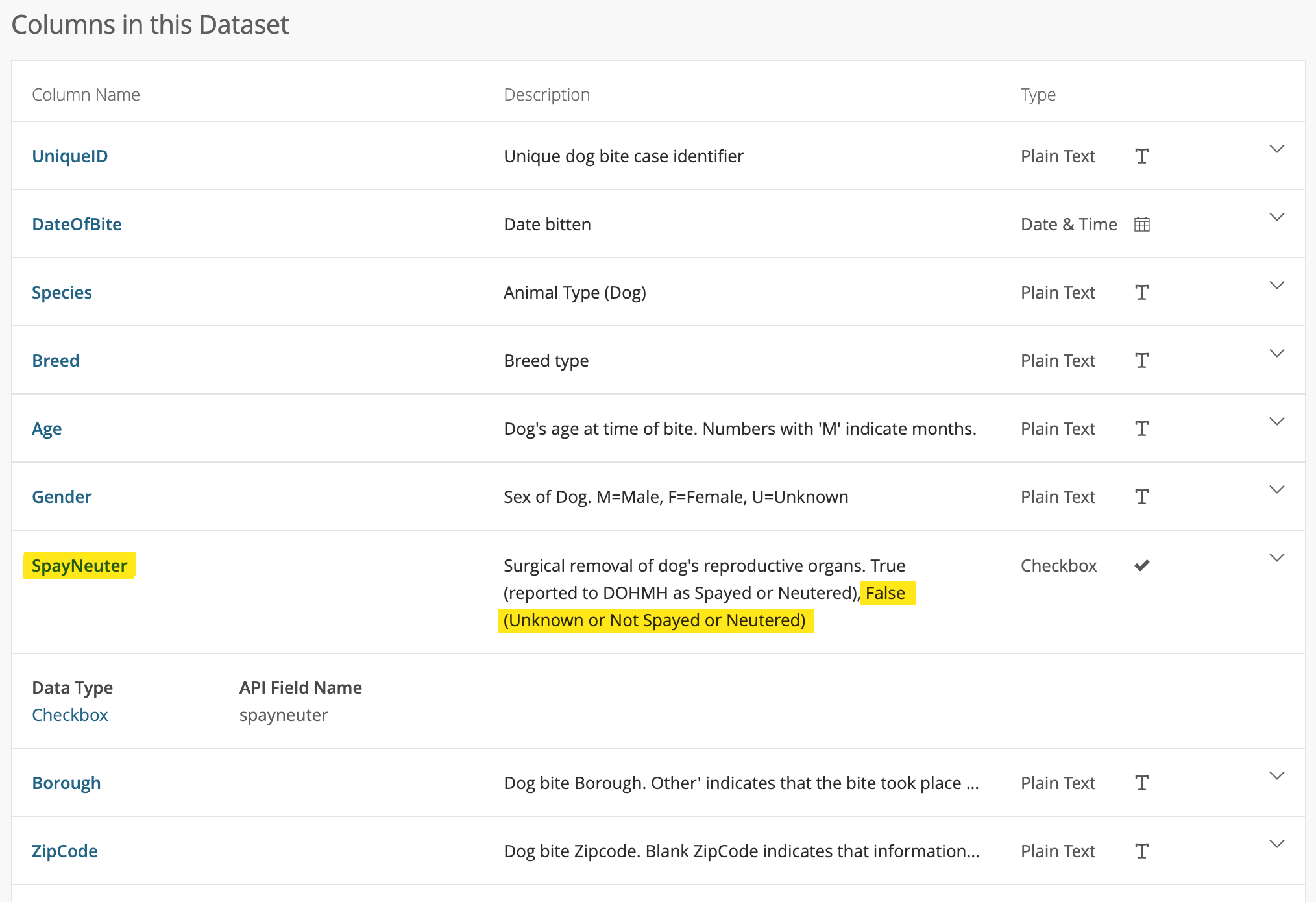
Also in February, we downloaded the dataset of dog bites collected by the Department of Health and Mental Hygiene (DOHMH). "Information on breed, age, gender and spayed or neutered status have not been verified by DOHMH and is listed only as reported to DOHMH," states the website. From January 1, 2015 to December 31, 2017, there were 10,280 reported dog bites. If one combines the many labels given to pit bulls (including, pit bull, pit bull mix, American pit bull mix/Pit bull mix, American Pit Bull terrier and more), pit bulls accounted for 34% (2915) of all bites when breed was known (8516) -- nearly 7 times more than the next breed, shih tzu and their mixes, which accounted for 438 bites.
DogsBite.org adapted dataset (PDF) | Dataset of bites by predominant breed (PDF)
City and County of San Francisco | Severity Data
In January 2019, we obtained dog bite statistical data by breed, injury severity and reproductive status from San Francisco Animal Care and Control over a 5-year period. From January 1, 2014 to December 31, 2018, there were 3625 total bites to humans and animals. Bites were separated into five levels of severity, 0 to 4, with 4 being the most severe. Of the combined categories of the most severe bites, Levels 3 and 4, there were 326 total bites. Pit bulls inflicted 46% (149) of these bites, over twice as many as the next closest breed, chihuahuas (60), and over twice as many as all other breeds combined (69). Sterilized dogs accounted for 73% (237) of these serious bites.
Louisville, Kentucky
Also in January, the Department of Public Health and Wellness in Louisville provided dog bite statistical data to WHAS 11, who was researching, "The trouble with pit bull adoptions." Of the 838 dog bites reported in 2018, 537 of them contained breed data. Pit bulls inflicted the lion share with 188 bites (35%) – nearly three times more any other breed. German shepherds followed with 65 bites and Labradors with 32. The piece also showcased a "long-stay" shelter pit bull named Pepperoni Pizza, "a very sweet and lovable boy" a volunteer said. But one week after WHAS 11 visited the shelter, "Pepperoni attacked another dog at the shelter," noted the news team.
URL:https://www.whas11.com/article/news/local/bad-breed-or-bad-rap-the-trouble-with-pit-bull-adoptions/417-c322bbbe-63a0-457f-8576-48a89952f097. Accessed: 2019-02-01. (Archived by WebCite® at https://www.webcitation.org/75rbDihM9)
San Antonio, Texas | Severity Data
Also in January, San Antonio Animal Care Services provided animal bite statistics to Fox 29 News. However, their Tableau dataset did not take into account the multiple names of the pit bull breed, which includes: American pit bull terrier, American Staffordshire terrier, pit bull and Staffordshire terrier. We adapted the dataset to do so. Over the 12-month period of October 1, 2016 to September 30, 2017 there were 3043 reported biting incidents. Dogs were responsible for 82% (2499). Pit bulls accounted for 26% (657) of all bites, followed by Labradors, 14% (360). Of the 120 dog bites categorized as "severe" injury, pit bulls were responsible for 47% (56).
DogsBite.org adapted dataset (PDF) | Raw dataset of all animal bites (PDF)
Casper, Wyoming
In October 2018, Casper Metro Animal Services provided animal bite statistical data to city council members. Over the 1.5 year period of January 1, 2017 to June 27, 2018, there were 721 reported animal bites in Casper, which has a population of 57,814, according to the US Census Bureau. Over 600 bites were attributed to dogs. Pit bulls and their mixes inflicted nearly one-third of these bites (199) and over twice as many bites as Labradors (92). German shepherds followed with 66 bites. Casper is currently drafting an ordinance that will "beef up" animal protections, despite the fact that it is human beings who are being bitten and attacked at a rate of 1.3 times per day.
St. Louis, Missouri
In June 2018, statistical data was released after St. Louis fulfilled a public information request by supplying a report of animal biting incidents in 2017. During the 12-month period, 205 animal bites were reported, of which 91% (186) were attributed to dogs. Pit bulls and their mixes were responsible for nearly 40% of all dog bites (72 of 186); over three times more than the next closest breed, Labradors and their mixes, attributed to 20 bites. By combining the two different shepherd results (14 and 11), German shepherds and their mixes inflicted 25 total bites. This is still three times less than pit bulls combined with American Staffordshire terriers, totaling 74 biting incidents.
Franklin County, Missouri
Also in June, the Franklin County Health Department issued a follow up report (see April listing below). This activity follows the dog mauling death of a 13-month old baby girl in Cape Girardeau in March. In the last 18 months, 315 animal bites have been reported in Franklin County, of which 231 have come from dogs. 56 (24%) of all reported dog biting incidents are attributed to pit bulls, more than twice the number as the next closest breed, mixed-breed, which accounted for 20 (9%). Labradors and their mixes followed with 10 (4%) biting incidents. These are the only three breeds with recorded bites in double digits. 91 bites (31%) had no documented breed information.
URL:http://www.emissourian.com/pit-bull-bites-top-county-statsn-just-under-percent/article_e4220a66-7069-5109-88cf-92c06bfa39b0.html. Accessed: 2018-06-10. (Archived by WebCite® at https://www.webcitation.org/704nIfvsZ)
Gulfport, Mississippi
In May 2018, after two pit bulls mauled an elderly woman to death in Gulfport, police released recent dog bite statistical data. From May 2016 to May 2018, there were 119 canine biting incidents. 106 involved dogs "at large" biting people, compared to 13 that were not at large. Pit bulls were responsible for over half in both categories. Pit bulls accounted for 53% (63 of 119) of the total incidents, including 53% (56 of 106) of at large incidents. Pit bulls inflicted 10 times more bites than the next closest breed, German shepherds, which accounted for 5% (6 of 119) of the total biting incidents. Labradors followed with 4% (5 of 119) of the total biting incidents.
URL:http://www.sunherald.com/news/local/counties/harrison-county/article211461194.html. Accessed: 2018-05-18. (Archived by WebCite® at https://www.webcitation.org/6zWNCOMi6)
Kansas City, Missouri
In April 2018, the Animal Health & Public Safety Department of Kansas City fulfilled a public information request by supplying a report of animal biting incidents in 2017. A total of 418 bites were reported to the department. Dogs inflicted 346 of these bites. Pit bulls inflicted the highest number of bites, 152 (44%), and four times more than the next closest breed, Labrador retrievers, which inflicted 38 (11%). German shepherds followed with 27 (8%) bites and American bulldogs with 14 (4%) bites. Notably, 21 (5%) of all reported animal bites in the entire city occurred at the Kansas City Pet Project Animal Shelter, which operates the city's open admission shelter.
Franklin County, Missouri
Also in April, the Franklin County Health Department stated that 31 animal biting incidents have been reported so far in 2018. 23 were dog bites and pit bulls inflicted 9 of them, 39%. Public Health Supervisor Tony Buel said that 2017 was the first year he began tracking breed data. "Pit bulls are the main breed we see bites from," Buel said, followed by Jack Russell terriers and mixed-breeds. For all of 2017, 219 animal bites were reported to the health department. Dogs inflicted 193 of those bites and pit bulls inflicted 43. Buel said the majority of severe injury dog bites come from pit bulls and cases with the worst damage almost always involve pit bulls.
URL:http://www.emissourian.com/local_news/county/dog-bite-injuries-may-lead-to-action-by-county-commission/article_42ab9d25-fe6e-5139-9543-828f2111325e.html. Accessed: 2018-04-05. (Archived by WebCite® at https://www.webcitation.org/6ySctVbgU)
Allegheny County, Pennsylvania | Registration Data
In January 2018, a study was published that examined 14,956 dog bite records in Allegheny County between 2007 and 2015. 6,191 cases listed a dog breed that excluded "mix-breed." Pit bulls constituted 27.2% of all dog bites, but only comprised 4.9% of the local dog population. German shepherds followed, which constituted 10.5% of all bites and comprised 5.2% of the registered dog breeds. Across age groups, pit bulls inflicted over 2 times more bites (66 v. 29) to children 0-3 years than any other dog breed; over 2.7 times more bites (90 v. 33) to ages 4-6 years; over 2.7 times more bites (207 v. 75) to ages 7-12 years; and 4 times more bites (184 v.46) to ages 13-18 years. (View chart)
Palm Beach County, Florida
In November 2017, Contact 5 published an investigation into dangerous dogs in Palm Beach County, Florida. By examining dog bite records, they discovered there were over 1,700 dog bites in the county last year, but less than 100 dogs were designated as dangerous, appearing on the county's dangerous dog list. The investigation broke down the dangerous dog list by breed (view related chart). Topping the chart were pit bulls (32) with over twice as many designated as dangerous than the next closest breed, Labrador retrievers (14). Through their investigative research, they also uncovered a fatal dog attack that occurred in late August in Lake Worth.
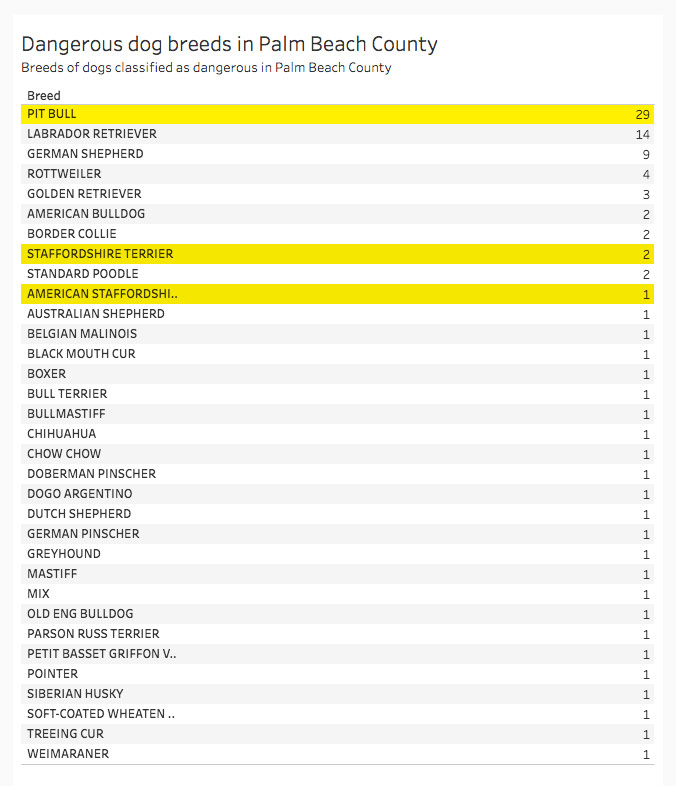
URL:http://www.wptv.com/news/region-c-palm-beach-county/contact-5-investigation-into-dangerous-dog-list-uncovers-fatal-palm-beach-co-dog-attack. Accessed: 2018-04-05. (Archived by the the Wayback Machine)
Pima County, Arizona
In October 2017, the Green Valley News published a powerful piece (From the Editor: No, these are not nice dogs) after Pima Animal Care Center dropped breed labels in order to adopt out more pit bulls to the unsuspecting adopting public. The editorial also cites Pima County dog bite statistics. "Pit bulls were responsible for 319 bites last year in Pima County, more than 50 percent higher than No. 2 German Shepherd (197)." Back in 2011, after a 4-year calculation of reported dog bites in Pima County, reported bites inflicted by pit bulls were only 34% higher than the next closest breed, German shepherds (pit bulls 848 bites, versus German shepherds 633 bites).
URL:http://www.gvnews.com/opinion/from-the-editor-no-these-are-not-nice-dogs/article_cb0cddb2-a8ab-11e7-b13b-5b97258e229e.html. Accessed: 2017-10-05. (Archived by WebCite® at https://www.webcitation.org/6tzvmHOhX)
Sacramento, California
In September 2017, The Sacramento Bee analyzed 2,800 bite reports made from May 2012 to May 2017. Of the 23 zip codes included in the analysis, two adjacent ones in North Sacramento -- 95815 and 95838 -- made up a quarter of all bite reports. Pit bulls dominated bite reports, responsible for more than one third of them. Of the 2,800 reported bites, pit bulls accounted for 922, more than four times more than the next closes breed, chihuahuas, which accounted for 225. Despite the "massive" disproportion, local animal-welfare officials dismissed this statistic, indicating yet again why such types have should have "zero role" in public safety.
URL:https://www.sacbee.com/news/investigations/the-public-eye/article174730246.html. (Archived by Wayback Machine)
Springfield, Missouri | Severity Data
In August 2017, the Springfield-Greene County Health Department released dog bite statistical data after a proposed pit bull ban. Despite already being regulated by the city, pit bulls lead all other breeds in biting incidents, accounting for 38 between 2015 and 2017. The agency also released severity of injuries using the Dunbar Scale, where 1 is aggressive behavior and 6 results in death. Pit bulls were responsible for 15 Level 2 bites, 15 Level 3 bites, 5 Level 4 bites, and 3 Level 5 bites. Pit bulls are the only breed responsible for a Level 5 attack (multiple bites at Level 4 or above; a concerted, repeated attack) during the period, according to the data.
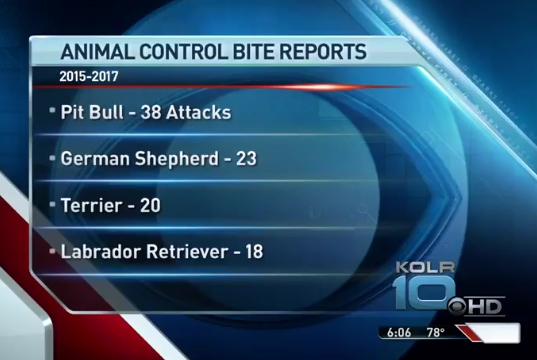
URL:http://www.ozarksfirst.com/news/sgf-city-memo-reveals-dog-bite-statistics/798297832. Accessed: 2017-08-26. (Archived by WebCite® at https://www.webcitation.org/6t0bLJEEN)
Pueblo, Colorado
In June 2017, after two life-threatening pit bull attacks required victims to be airlifted to trauma hospitals, Pueblo Animal Services (PAS) released dog attack statistics. Of the 13 dog attacks on humans this year, 11 have involved pit bull-type dogs, according to Lindsey Vigna, lieutenant of animal law enforcement for PAS. The vicious attacks, occurring less than a week apart, involved two family pit bulls attacking an elderly woman who suffered severe facial, hands and torso injuries, along with a fractured jaw. The other attack involved an 18-month old boy mauled by a family pit bull-mix at his home. The boy suffered severe injuries to his head, face and neck.
URL:http://www.chieftain.com/news/pueblo/pueblo-boy-severely-hurt-in-attack-by-family-dog-animal/article_20af9b41-6e4d-5d08-a8d6-d92ed74ec546.html. Accessed: 2017-06-15. (Archived by Archive Is at https://archive.is/5qxkl)
Lena Howland, "Pueblo grandmother attacked by pit bulls," KOAA News, June 9, 2017 (koaa.com)
URL:https://web.archive.org/web/20170722074101/http://www.koaa.com/story/35631598/pueblo-grandmother-attacked-by-pit-bulls. Accessed: 2017-06-15. (Archived by WebCite® at https://www.webcitation.org/6rF4eSQlo)
Broward County, Florida
Also in June, the Broward County's Animal Care and Adoption Division reported the county's top three biting breeds from June 2016 to June 2017. American Staffordshire terriers (an interchangeable name with pit bull terriers) led with 92 biting incidents, followed by pit bull terriers with 26 biting incidents. The third highest-ranking breed, Labrador retrievers, had 22 biting incidents. Officials in Tamarac, also located in Broward County, said there had been only two pit bull-related bites in the city over the past few years. Tarmac has had a pit bull ordinance in place since 1985. Soon, only Sunrise and Miami-Dade County will regulate pit bulls in south Florida.
Dayton and Montgomery County, Ohio
In late April 2017, the Dayton Daily News reviewed dog biting incidents in the city and county after a pit bull broke free of its chain and fatally attacked a 60-year old man. According to the Public Health Department of Dayton and Montgomery County, there were 169 reported dog bites from owners who resided in Dayton last year. So far this year -- from January 1 to late April -- there were 56 reported dog bites from dogs whose owners live in Dayton. "In Montgomery County, there have been 245 reported dog bites so far this year. About 60 (24%) of the bites involved pit bulls, which was far more than any other breed identified," reports the Dayton Daily News.
URL:https://www.daytondailynews.com/news/local/dayton-man-mauled-dog-that-neighbors-had-worried-about/S38cxDYrJnydT2UX0rAvZM/. Accessed: 2017-04-26. (Archived by WebCite® at https://www.webcitation.org/6q1REVrTG)
Cape Cod, Massachusetts | Registration Data
In March 2017, the Cape Code Times reviewed dog bite and registration records across Cape Cod. Between January 2016 and February 2017, pit bulls had the most biting incidents, 58, nearly twice as many as the next closest breed, Labrador retrievers, which inflicted 29 bites. German shepherds followed, inflicting 26 bites. Pit bulls represented 12.6% of the breeds listed on bite reports, but only make up 1.2% of the registered dogs. In contrast, Labrador retrievers were 6.3% of the breeds listed on bite reports and make up 11.5% of the registered dogs. German shepherds represented 5.7% of the breeds listed on bite reports and make up 2.2% of the registered dogs.
URL:http://www.capecodtimes.com/news/20170313/cape-cod-breeds-by-bite. Accessed: 2017-03-14. (Archived by WebCite® at https://www.webcitation.org/6oyF8q7s0)
Montreal, Quebec | Severity & Registration Data
In a special addition, we are including statistics for the city of Montreal, poised to adopt a pit bull ban on September 27, 2016. The legislation comes three months after the brutal mauling death of Christiane Vadnais, killed by a neighbor's pit bull. On the eve of this historic vote, Montreal officials released dog biting incident statistics. Over the past 1.5 years, 362 serious dog bite incidents required police intervention. Since January 1, 2015, 137 people and animals have been badly injured or killed by pit bulls or pit bull crossbreeds. Pit bulls, which account for just 4.6% of registered dogs in Montreal, are responsible for 38% of all serious dog bite-related injuries.
Port Huron, Michigan
In January 2016, after the back-to-back fatal pit bull attacks of 22-year old Rebecca Hardy in Port Huron and 4-year old Xavier Strickland in Detroit, The Times Herald published dog bite statistics for Port Huron, a city with about 30,000 people. In 2014, pit bulls were responsible for over half of all dog bites in the city. There were 61 reported dog bites in 2014, and 33 of those were inflicted by pit bulls. This is in contrast to the city of Toronto, a population of 2.6 million people, where pit bulls only inflicted 13 bites in 2014. The Province of Ontario adopted a pit bull ban in 2005. Since this time, attacks inflicted by pit bulls in Toronto, Ontario's largest city, have dropped by 92%.
Eric Andrew-Gee and Joel Eastwood, "Pit bulls were Toronto’s biggest biters, before the ban,"
TheStar.com, October 3, 2014 (thestar.com)
URL:http://www.thestar.com/news/gta/2014/10/03/pit_bulls_were_torontos_biggest_biters_before_the_ban.html.
Accessed: 2014-10-06. (Archived by WebCite® at https://www.webcitation.org/6T834ej0h)
"Ontario’s pit bull ban is working and mustn’t be repealed: Editorial," TheStar.com, October 6, 2014 (thestar.com)
Cleveland, Ohio
In November 2015, Cleveland 19 published dog bite statistical data from Cleveland showing the results of two time periods. In 2014, pit bulls were responsible for 40% of all dog bites where the dog's breed was identified. During the next 8-month period, January 1, 2015 to August 12, 2015, pit bulls were responsible for 41% of all dog bites involving an identified breed. Despite this, the city's Chief Animal Control Officer, Ed Jamison, denied that pit bulls posed a danger to the public and also denied that the city shelter -- with a pit bull occupancy rate of 40% -- posed a problem to the shelter. Cleveland 19 dubbed the city shelter, "The Pit Bull Motel." (View: full data file).
Hastings, Michigan
In October 2015, Hastings city officials discussed repealing their pit bull ordinance that prima facie declares pit bulls "dangerous." During discussions, Hastings City Police Chief Jeff Pratt shared statistics on dog-related complaints dating back to 2011. The statistics showed that 48% of all dog bites involved pit bulls, 41% of dangerous or aggressive dog complaints involved pit bulls and 66% of dogs shot by officers were pit bulls. Overall, “45.7% of our dog calls involve the pit bull breed,” Pratt said. “To me, this is a very significant number." These statistics clearly show that removing the existing ordinance, which does not prevent people from owning pit bulls, is injudicious.
Sandra Ponsetto, Dog discrimination to be a thing of the past for City of Hastings, Hastings Banner, October 29, 2015 (hastingsbanner.com) URL:http://hastingsbanner.com/dog-discrimination-to-be-a-thing-of-the-past-for-city-of-hastings-p8148-84.htm. Accessed: 2015-11-12. (Archived by WebCite® at https://www.webcitation.org/6czT5H6Bn)
Orange County, Florida
In June 2015, WKMG 6 News published the results of county dog bites over a 1-year period. From October 2013 to September 2014, Orange County Animal Services issued 331 citations to dog owners for failing to control their pets that resulted in a bite. Pit bulls and their mixes were responsible for 35% of all bites. Labradors followed in distant second place with 7%. German shepherds and chihuahuas each made up 6% of all reported bites. The records showed that 7% of all bites occurred when someone tried to break up a fight between two dogs or rescue a dog being attacked by another dog and 2% of the owners were repeat offenders. (View: graphic chart).
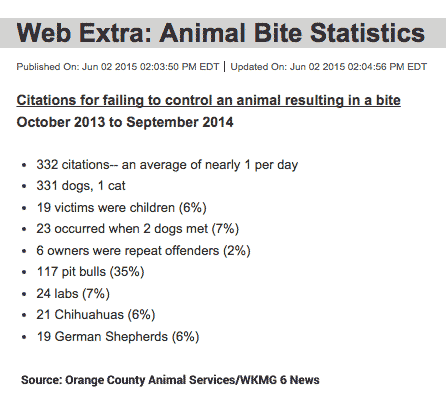
"Web Extra: Animal Bite Statistics," WKMG 6 News, June 2, 2015 (clickonorlando.com) URL:http://www.clickorlando.com/news/web-extra-animal-bite-statistics/33356480. Accessed: 2015-06-03. (Archived by WebCite® at https://www.webcitation.org/6Z1dDCYdp)
Portland-Area, Oregon | Registration Data
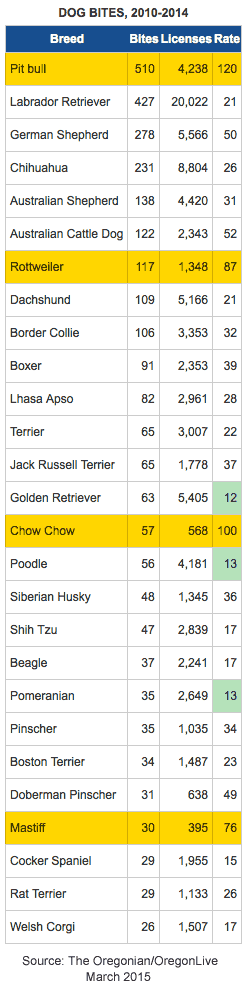
In March 2015, the Oregonian released results of an investigation of Portland-area dog bites since 2010. The investigation showed that there were 3,940 total biting incidents. Pit bulls inflicted 510 of these bites and were responsible for more bites than all other dog breeds. Labrador retrievers, which outnumbered licensed pit bulls by nearly 5-to-1, fell at a distant second with 427 bites. Among the highest biting rates by breed, pit bulls were number one with a 120 rate, followed by chows with a 100 rate, rottweilers 87 and mastiffs 76. The lowest biting rate breeds were golden retrievers, poodles and pomeranians with 12 and 13 rates accordingly (View: graphic chart).
Maricopa County, Arizona | Registration Data
In January 2015, a study examining dog bite injuries at the level 1 trauma pediatric center in Phoenix was released (study years of 2007-2013). "Pit bulls were most frequently responsible, accounting for 39% (83/213) of incidents in which dog breed was documented," states the study. The study only examined patients whose intake was by ambulance. The study also examined county dog licensing records from 2008 and noted, "Pit bulls accounted for 6.25% of the licensed dog population, only the seventh most popular breed." Labradors were the most popular breed (25.7%) in the county, but only accounted for 3.5% of the patients in the dog bite injury study.
Houston, Texas
In November 2014, ABC 13 Eyewitness News did an investigation into the number of dog bites in the city of Houston. This is the first known reporting of total dog bites in Houston on record in many years (and possibly ever). Statistics pertain to January 1, 2014 to September 24, 2014 and were supplied by the Bureau of Animal Regulation and Control (BARC).1 Of the 1,540 total reported bites during this period, pit bulls led with 518, double the number of the next topmost biting breed, German shepherds with 253 biting incidents. Labradors followed in third place with 171. Notably, Belgian malinois were also represented in fifth place with 37 (View: graphic chart).
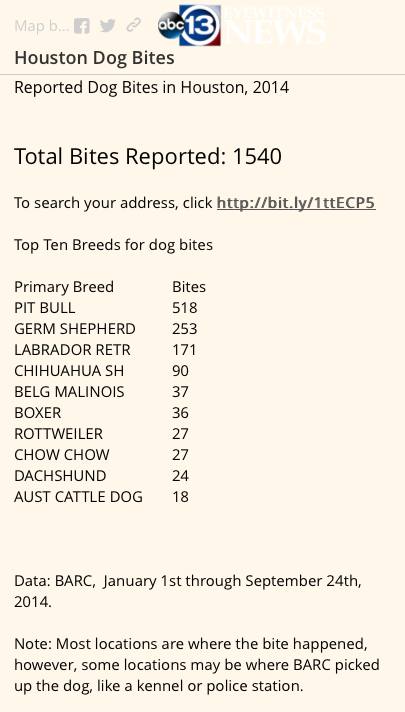
Houston Dog Bites, January 1st through September 24th, 2014, Source: BARC (Archived by DogsBite.org)
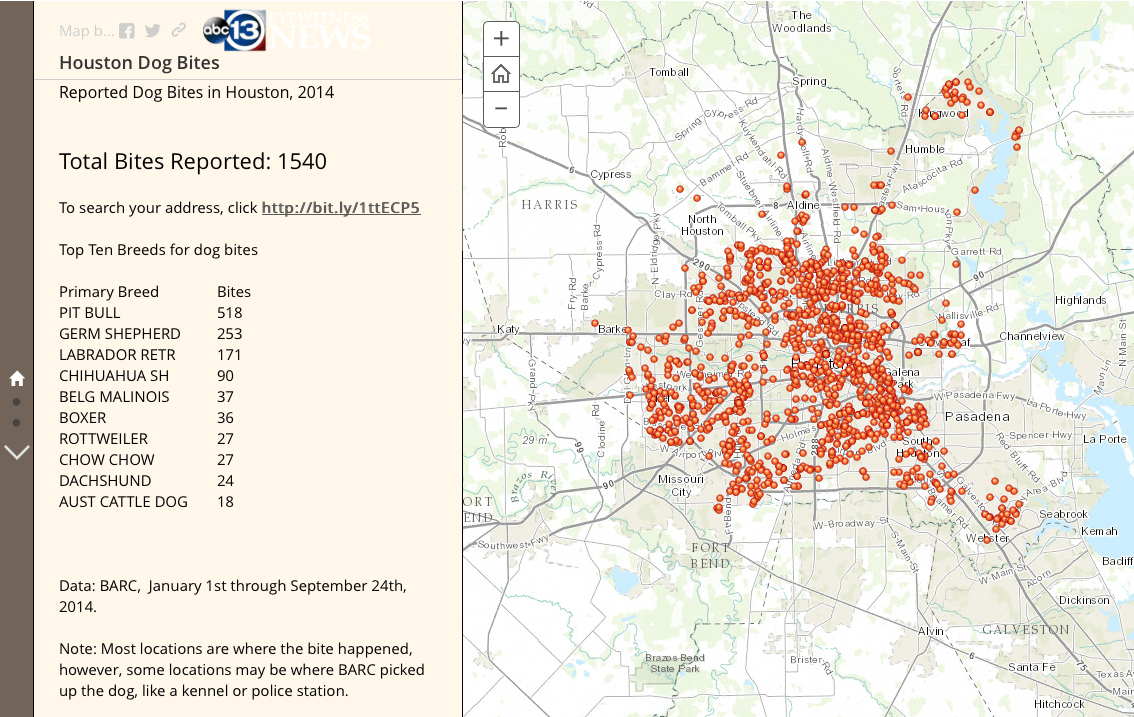
1We do not believe bites reported in unincorporated Harris County were included.
San Diego County, California
Also in November, NBC 7 released an investigative report after examining 7,600 bite reports between July 2011 and June 2014 in the jurisdiction of Animal Services, which includes the unincorporated portion of the county, and the cities of San Diego, Carlsbad, Santee, Solana Beach, Del Mar and Encinitas. Pit bulls had the most bites, a total of 851 during the 3-year period. Followed by German shepherds with 349 (less than half). In the 11-month period of December 2011 to November 2012, dogs in San Diego County killed four people, five if one includes a San Diego pit bull that was taken across the border and within a week killed a little girl in Tijuana.
Des Moines, Iowa | Registration Data
Also in November, after city council wrestled with pit bull advocates about their ordinance that declares pit bulls "vicious," assistant city manager Kandi Reindl presented data showing that pit bulls, despite being regulated, still bite more frequently than the most popular dog breed. The fist six months of data from 2014 showed that pit bulls were responsible for 27 biting incidents, more than any other breed out of 150 bites. Labrador retrievers followed with 14. However, there are 1,831 licensed Labradors compared with 466 licensed pit bulls, according to city data. "We have more bites by a pit bull than a Lab and there are four times as many Labs in the city," Reindl said.
Pennsylvania State
In September 2014, after a 20-month old boy was badly bitten in the face by his grandmother's pit bull in Manheim Township, the LancasterOnline wrote an editorial (Pit bulls and small children may be dangerous mix) and provided state dangerous dog designation statistics. Of the 562 dogs on the Pennsylvania Department of Agriculture’s Dangerous Dog registry, pit bulls accounted for a whopping 41%. The next highest category on the list, mixed-breeds (non-pit bulls), accounted for 23%. "That is not even a single breed," notes the editorial. The single breed with the second-highest percentage on the list were German shepherds, accounting for just 7%.
King County, Washington | Registration Data
In August 2014, after a series of pit bull attacks in Western Washington, KIRO 7 obtained bite statistics from area municipalities and learned that pit bulls are 8.5 times more likely to attack than other dog breeds. Of the areas investigated, King County, Pierce County, Snohomish County and the city of Tacoma, only King County collected dog bites "by breed." In that county (excluding Seattle), there were 178 total dog bites in 2013. Pit bulls led all breeds with 36 bites, followed by Labrador retrievers with 28 bites. However, there are 16,651 Labradors and only 2,520 pit bulls registered in the county, indicating that pit bulls are 8.5 times more likely to bite than Labradors.

Boston, Massachusetts | Registration Data
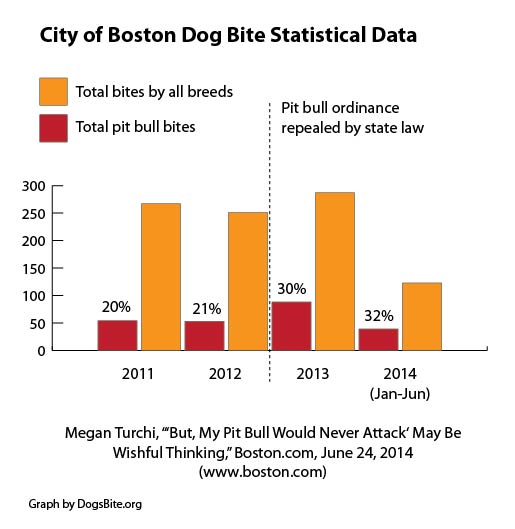
In June 2014, Boston.com published an article titled, 'But, My Pit Bull Would Never Attack' May Be Wishful Thinking. The publication then plowed through several years of dog bite statistics. From January 2012 to June 2014, there were 661 total dog bites in Boston, which includes bites against human, animal and unknown victims. Pit bulls and their mixes were responsible for 27% (180), despite pit bulls only making up 3% of the registered dog population. In 2012, a state preemption law signed by Governor Deval Patrick struck down the city of Boston's Responsible Pit Bull Ownership Act. Ever since, attacks by pit bulls have been on the rise. See: related graphic.
Hamilton County, Ohio
Also in June, after one of the worst attacks the region has ever seen, Hamilton County Health Department data showed that from January 1 to May 11, 2014, there were 38 biting incidents involving pit bulls and their mixes. In 2013, there were 74 total pit bull biting incidents. 2014 is on pace to top the total reported in 2013. Notably absent from the data is 2011 comparison statistics when Cincinnati still had a pit bull ban. Cincinnati repealed their longstanding ban in May 2012. The recent victim, 6-year old Zainabou Drame, suffered unimaginable injuries, including her tongue ripped out and her jaw torn off. Two pit bulls latched onto her face and pulled it apart.
Tom McKee and Greg Noble, "Girl's family says 6-year-old suffered horrific injuries in pit bull attack in Westwood," WCPO Cincinnati, June 6, 2014 (wcpo.com) URL:http://www.wcpo.com/news/local-news/pit-bulls-attack-child-in-front-of-westwood-home. Accessed: 2014-06-21. (Archived by WebCite® at https://www.webcitation.org/6QVIr2XEo)
Franklin County, Ohio
In May 2014, Franklin County Department of Animal Care and Control released 2013 statistics showing Nuisance, Dangerous and Vicious Designations by Breed (See: data chart). This data is a reflection of the new state law adopted in 2012. Pit bulls topped the charts in all three categories. Of the 208 total Nuisance designations in 2013, pit bulls received 79 (38%), followed by "mix" with 69 and Labradors with 8 -- pit bulls towering over Labradors by a 888% margin. Of the 291 total Dangerous designations, pit bulls received 124 (43%), followed by "mix" with 87 and German shepherds with 15. Of the 23 total Vicious designations, pit bulls received 13 (57%).
Madison, Wisconsin
In February 2014, Alderman John Strasser introduced a pit bull sterilization ordinance to combat shelter overpopulation and a disproportionate number of attacks by pit bulls. Statistics complied by Public Health Madison and Dane County showed that: "More than half of the dogs euthanized at the humane society during 2010-12 were pit bulls … Pit bulls accounted for 12 percent of incidents involving dogs biting humans and 38 percent of the dog-on-dog attacks in the city in 2013. They also made up 21 percent of the cases of dogs running at large and 48 percent of abandoned dogs. Of the 15 dogs that were declared dangerous during 2011-13, 93% (14) were pit bulls."
Bullhead City, Arizona
In January 2014, after a pit bull repeatedly escaped its yard terrorizing citizens and killing a pet dog, Bullhead City Police Department released dog bite statistics. The statistics showed that pit bulls were responsible for nearly half of all biting incidents. In 2013, animal control officers responded to 126 dog bites. Of these bites, (48%) -- 60 -- were inflicted by pit bulls and their mixes. The other half was spread among a variety of breeds. The release of the statistics and discussion of creating a stronger dog ordinance came just weeks after a Bullhead City man was fatally injured by his own five large dogs trying to break up a dog fight in late December.
Medford, Oregon
Also in January, Medford City Council began considering ways to crack down on the growing number of attacks by dangerous dog breeds. In the past three years, 89 reports of dog bites were received, according to the Medford Police Department. Pit bulls were involved in half of the attacks, and pit bulls or their mixes were responsible for 8 of the 11 fatal attacks on animals. Councilor Karen Blair began looking into the matter after a series of aggressive dog-on-dog attacks. Blair wants to review how other cities have controlled the problem, which includes reviewing cities with pit bull bans, mandatory pit bull sterilization or insurance requirements.
Related articles:
03/10/25: Report: Countries Worldwide that Restrict Dangerous Dog Breeds - DogsBite.org
07/15/23: Table: Level 1 Trauma Center Studies of Severe Dog Bite Injuries - 2011 to 2022
04/01/17: Cities with Successful Pit Bull Laws; Data Shows Breed-Specific Laws Work
10/10/16: Special Report: Level 1 Trauma Center Dog Bite Studies in All U.S. Geographical...
10/10/16: Table: Level 1 Trauma Center Studies of Severe Dog Bite Injuries - 2009 to 2016
08/31/15: Who Can Identify a Pit Bull? A Dog Owner of 'Ordinary Intelligence'...
Great info here! Despite the true facts you have presented the pit bull lobby will still tell people that they are safe for families! I hope people wake up soon to the truth!
The pit bull people and the people who just don't know or just don't have an opinion on these dogs will never believe this. Everytime I read the comments on the news articles after attacks there are plenty blaming chiuhuahuas, poodles, labs, and "all toy dogs." We all know otherwise.
Good point, responsible dog guy. I just saw a Nextdoor post from some fellow Tucsonan who was missing the family pit bull. And, you're gonna love this part, it was a service dog for the family's autistic child.