In the 15-year period of 2005 through 2019, canines killed 522 Americans. Pit bulls contributed to 66% (345) of these deaths. Combined, pit bulls and rottweilers contributed to 76% of the total recorded deaths. | More »
Victim Identified UPDATE 06/11/14: Holden William Garrison of Davisburg died Sunday morning after being viciously attacked by his family's dog. At the time of the attack, the baby's uncle was holding the child while on the couch with his mother sitting nearby. The dog suddenly jumped up and latched onto the infant's head and throat. The child's father "pried the dog's jaw open" to free the baby. The child died after being transported to two hospitals. The dog is being euthanized today.
The boy’s funeral service will be held at 1 pm on Friday at Coats Funeral Home in Clarkston.
**Clarification** The owner(s) of the dog have been reported in multiple ways: the child's family, the child's parents and the child's uncle. We believe the most accurate is the child's parents and that the dog had lived with the baby's parents for at least two years, as stated in early news reports (See more information in the comments section). Also, the dog was not euthanized today as reported earlier by the Daily Tribune. The dog is "scheduled" to be euthanized this week.
06/09/14: Cause of Death Ruled
The fatal attack occurred in the unincorporated community of Davisburg. Oakland County sheriff's deputies responded to a home in the 8000 block of Tindall Road, where they found the boy's father preparing to take his 10-week old son to the hospital. Deputies immediately began giving the baby CPR. The Springfield Township Fire Department transported the child to Genesys Regional Medical Center. He was then airlifted to Royal Oak Beaumont, where he died.
The Oakland County Medical Examiner’s office ruled the cause of death as multiple head trauma and the manner as accidental. According to Oakland County Animal Control Administrative Supervisor Sgt. Joanie Toole, the 3-and-a-half-year old dog, named "Precious," is currently in quarantine. Despite earlier reports, Toole said the owners have not yet released custody of the "Catahoula cattle hound" to animal control. If custody is surrendered, the dog will be put down.
The Clawson Patch states that the dog belonged to the child's 18-year old uncle, who had been holding the child on the couch. The uncle had been "staying with the family temporarily," according to deputies. Also sitting on the couch when the dog attacked was the boy's mother. Both she and her brother tried to fight off the dog and screamed for the child's father to help. The father received multiple injuries requiring stitches after "prying open" the dog's jaws to release the baby's head.
The brother told deputies he was holding the baby when the dog jumped on the couch and the brother pushed it away. The mother sat down next to the brother and the dog then jumped on the couch and began biting the infant’s head and throat area. The mother and brother began fighting with the dog and screaming for the father. The father responded and put his hands inside the dog’s mouth to pry the dog’s jaws open. - Mike Martindale, The Detroit News
06/09/14: Family Dog Kills Infant
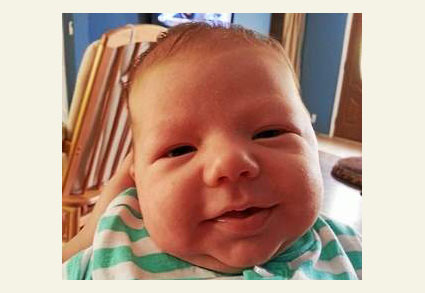
Springfield Township, MI - In developing story, a two-and-a-half month old boy was viciously attacked and killed by his family's "Catahoula cattle hound" on Sunday. At the time of the attack, the baby's 18-year old uncle was holding him on the couch. The dog tried to jump on the couch, but was pushed away. The dog jumped up again, this time attacking the baby's head and throat. His 26-year old father "pried the dog's jaws open" to free his son and also sustained injuries.
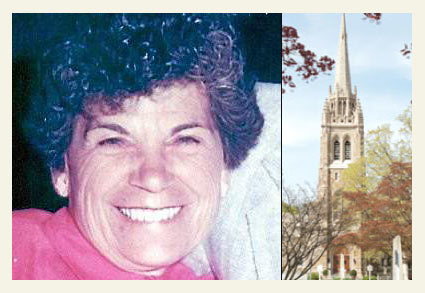
Rita Pepe, 93-years old of Branford, Connecticut died on May 25, 2014.
Mauling Victim Dies
Branford, CT - On April 13, 93-year old Rita Pepe was savagely attacked while walking in her neighborhood by a recently adopted pit bull that charged out of its owner's home. Bill Cronin, one of several neighbors who came to rescue her, told WTNH.com, chillingly, "A large dog emanated from the back of [the] home, and we thought it was chasing a fire truck,” Cronin said. "Then it made an immediate right turn and took this elderly woman down like a wounded animal."
On Tuesday, her son confirmed that she died. Charlie Pepe said his mother "probably" died of kidney failure, but doctors told him the trauma and extended inactivity due to the bite injuries worsened her condition. "It's all related in one way or another," he said. When he received the call from his brother saying that their mother was being taken to the hospital, he assumed a fall or a stroke. He said he never would have guessed, "it was because of being bitten by a pit bull."
Background: The April 13 Attack
At the time of the attack, neighbors said the dog's owner, 49-year old Matthew Radulski, had only had the animal for a few months. "The owners were usually very diligent. They always had him on a leash, they were always training him,” neighbor Charlie Davis said. "From what I know, they actually even hired a professional trainer to work with the dog." According to Branford police, she sustained "very serious injuries" to her lower left leg and was taken to Yale-New Haven hospital.
"We hope she recovers from this brutal attack," Capt. Geoff Morgan told the Branford Eagle. "These are very serious injuries."
The Branford Eagle obtained two 911 calls. Officer Joseph Harrington, who conducted the investigation, said the dog ran from inside the owner's home and attacked the woman as she was walking. Neighbors tried to fight off the dog using the victim's cane and a baseball bat. Sgt. Richard Dahlin, who supervised the incident, said the victim sustained a massive amount trauma to her lower left leg. She was taken to an area medical center and underwent surgery, he said.
The New Haven Register published a subsequent article that disclosed where the dog had been adopted from, the Dan Cosgrove Animal Shelter (Branford Animal Shelter). The pit bull, named "Booker" was adopted from the shelter by Radulski in September.1 Shelter Director Laura Burban told The Register that prior to adoption, Booker "underwent extensive evaluations by staff, volunteers and trainers." She added, "He did not show a propensity of violence towards people."
Hence the reason why many shelter "evaluation" systems and temperament tests examined in studies are shown to be unreliable and may have potentially devastating consequences. Please see three related studies: Development of the behavioural assessment for re-homing K9's (B.A.R.K.) protocol (2013); Reliability, validity and feasibility of existing tests of canine behaviour, (2009) and Aggressive Behavior in Adopted Dogs that Passed a Temperament Test (2007).
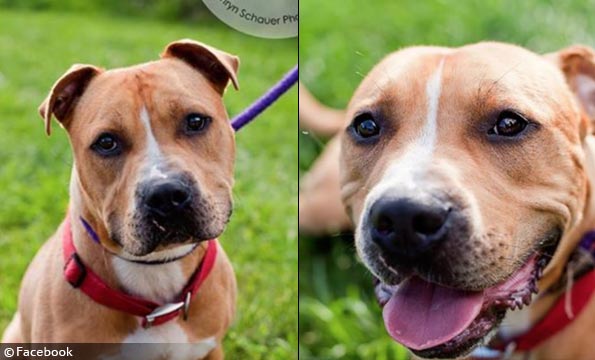
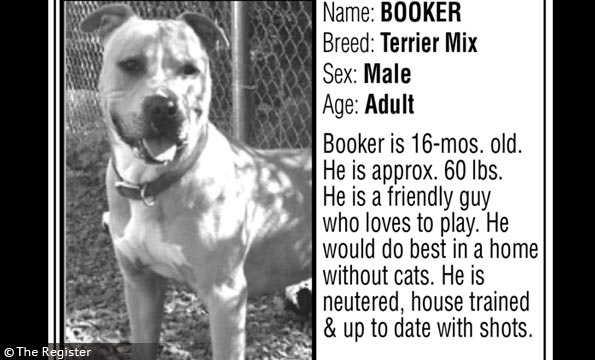
Burban denied The Register access to take any photographs of the dog, so the writer did some Googling and found a variety of images of the dog. Several stemmed from a Facebook page (since removed, see: PDF file of screen capture) that supplied images for the dog's Petfinder advertisement. An Adopt-A-Pet advertisement published in The Register was also located and shows that Booker had been misleadingly labeled a "terrier-mix" (See row three left image).
Branford Animal Shelter Adoption Listing
Name: Booker
Breed: Terrier-Mix
"Booker is 16-months old. He is approx. 60 lbs. He is a friendly dog who loves to play. He would do best in a home without cats. He is neutered, house-trained and up to date with shots."
Interestingly, The Register article also positioned this as an "alleged attack." Booker is "accused" of attacking and police responded to the "alleged attack," states the article. These words were still used after examining Officer Harrington's report which stated that "numerous witnesses" told police the dog attacked Pepe and even included sworn testimony by Radulski, stating that "he had to strike Booker over the head numerous times with a rock in order to get him away from Pepe."2
Lastly, a follow up by The Eagle on April 17 contains more information about Pepe's serious injuries. One of her son's told The Eagle that the surgeon told him on April 16, "the best thing is she will walk again and the worst thing is she will lose her leg. It could go either way." Her son added, "The wound is so big, so deep their fear is they don’t know what they will be able to do. They are discussing skin grafts." Her recovery is not in weeks, but months, her son said.
The Eagle piece also contains more reasons why Director Burban should be fired. She defended adopting out the attacker, "They only thing we knew is that he did not like cats." She theorized the dog attacked because the victim was holding a cane and the dog felt threatened. She defended her mislabeling of the dog and fired up the "media conspiracy" routine, "golden retrievers have killed children and done all kinds of other terrible things. But we never hear about it," Burban said.
Alerted Local Media About Her Death
On June 2, the Protect Children from Pit Bulls and Other Dangerous Dogs Facebook page alerted DogsBite to a comment that stated Pepe "never recovered from her injuries and remained bedridden until death." They also sent Pepe's obituary web link. We quickly contacted several local media groups that covered the April attack; two indicated they were looking into the matter. On June 3, The New Haven Register published the follow up article about Rita Pepe's death.
Like The Register, we too wonder what became of Booker? It seems no one will say six weeks after a violent, unprovoked attack that contributed to the death of Rita Pepe. The Director of Branford Animal Shelter, Laura Burban, who adopted out the attacker, stated her commitment to rehoming vicious dogs in 2010. The dog's owner, who is "devastated" over the mauling, according to Pepe family members, is mum on this issue. Our guess is that Booker is alive and kicking.
Booker, a pit bull-mix, seen on the photographer's Facebook page for his PetFinder images.
Booker advertised in The New Haven Register by the Branford Animal Shelter as a "terrier-mix."
1Burban told the Eagle the next day that Matthew Radulski adopted the dog on October 2, 2013. 1It appears there was an effort mounted by a source or sources claiming Booker had actually not attacked Pepe, thus the reporter used the "allege" language. We did not find similar "allege" language in any other news reports; so hopefully that sinister and ethereal effort died on the day of its publication, April 16.
Included: Timeline of Major Events from 2007 to 2014
Annapolis, MD - On April 8, Governor Martin O'Malley signed Senate Bill 247 into law abrogating the Court of Appeals of Maryland's decision in Tracey v. Solesky. The 2012 decision declared pit bulls "inherently dangerous" and attached strict liability when a pit bull attacks a person. This liability extended to landlords when a tenant's pit bull attacks. DogsBite.org submitted an amicus brief to the high court on behalf of the young mauling victim. The high court agreed with our brief.
Headlines emerged after the bill passed both chambers stating that legislators had "overturned" the high court ruling. What is more accurate is that legislators crafted legislation that muted the Court's decision, passed it through both houses and the governor signed this bill into law.1 Despite this legislative action, the Solesky decision lives on. Lawyers and judges across the U.S. will still be able to cite the Solesky decision as the seminal case declaring pit bulls "inherently dangerous."
New law reigns in Maryland, but the value of the Solesky decision in 49 other states is not lost.
Legislators Did Not Craft What We Had Hoped
In the timeline of events (at the bottom of this post), we briefly explain the four legislative sessions the various bills took to finally reach approval by both bodies. Whether or not to abrogate the decision was never up for debate; all versions of both House and Senate bills contained the full abrogation of the Solesky decision. Given that this was true, the Solesky family, their attorney and DogsBite.org quickly moved to support a meaningful strict liability bill inclusive of all dog breeds.2
A strict liability standard would advance the rights of all Maryland dog bite victims, who pre- and post-Solesky were subject to the one bite rule.
During the 2nd Special Session in 2012, this strict liability bill was put forward and voted down by the House. Next came the first "compromise" bill, also known as the rebuttable presumption bill during the 2013 Regular Session. The key defect of this bill was the low level of evidence a dog owner would need to rebut the presumption, only "by a preponderance." When the Senate amended it, raising the threshold to "clear and convincing" evidence, the House crushed the bill.
When the 2014 Regular Session began, we received bad news from legislative insiders, "It's all about landlord relief," and "something will pass this session." Notably, landlord relief has nothing to do with pit bulls or the overly orchestrated animal welfare lobby that frankly had no understanding as to why the 2013 bill failed. The bill failed due to the House's desire to codify the one bite rule into law (rebuttable presumption bill) versus the Senate wanting a uniform strict liability bill.
With the House and Senate still at odds in 2014, a second poor rebuttable presumption bill was introduced by the same sponsors, Del. Luiz Simmons and Sen. Brian Frosh, with one new twist. The new legislation (SB 247) guaranteed the victim a jury trial -- the 2013 version allowed for a summary judgment by a judge, denying the victim a jury trial. The Senate was at least able to attach an amendment holding owners of "at large dogs" that attack a person strictly liable.
Overall, a paltry and embarrassing response by Maryland legislators to the landmark ruling by the Court of Appeals in Tracey v. Solesky.
How Should Have Legislators Responded?
It was expected that the legislature would act after the high court's ruling. The Solesky decision blared a horn at the inadequacies of Maryland's one bite rule. But the Court could only rule on what was before it, which were multiple appellate decisions involving pit bull injuries and premise liability prior to Solesky. The main decision was Matthews, which placed landlords on notice of the dangerousness of pit bulls in 1998 and was the means for the Solesky family to bring a civil claim.
The Solesky decision should have been the benchmark to advance more meaningful legislation to provide stronger protections for all Maryland dog bite victims. The legislature should have acted by keeping the decision intact and creating a strict liability statute for all dog breeds, as are present in 30 other U.S. states. As for landlord liability, the high court left open the possibility of adding rottweilers at a future time, the second most recognized, well-documented dangerous dog breed.
Will the Pit Bull Mauling Issue Go Away?
As five Maryland appellate court cases have already shown legislators, No.3 The issue of "who pays" after a violent pit bull attack -- four of the five appellate cases involved landlord liability -- is tantamount in the state. The new law rolls back landlord liability to pre-Solesky, Matthews (1998), which created the conditions for the Solesky family to file their lawsuit. If a pit bull mauling case emerges in the future that mirrors circumstances in Solesky, that attorney will cite Matthews too.4
The extreme dangerousness of this breed, as it has evolved today, is well recognized. "Pit bulls as a breed are known to be extremely aggressive and have been bred as attack animals." Giaculli v. Bright, 584 So.2d 187, 189 (Fla.App. 1991). Indeed, it has been judicially noted that pit bulls "bit[e] to kill without signal" (Starkey v. Township of Chester, 628 F. Supp. 196, 197 (E.D. Pa. 1986)), are selectively bred to have very powerful jaws, high insensitivity to pain, extreme aggressiveness, a natural tendency to refuse to terminate an attack, and a greater propensity to bite humans than other breeds ... ("pit bull dogs represent a unique public health hazard ... [possessing] both the capacity for extraordinarily savage behavior ... [a] capacity for uniquely vicious attacks ...- Court of Appeals of Maryland
Further, as shown in the Solesky decision, substantial new evidence documenting the dangerousness of the pit bull breed has developed since 1998, including multiple scientific peer-reviewed studies and appellate decisions in other states. As Baltimore Sun columnist Dan Rodricks pointed out after the 2014 Session, any person with access to Google Search can see for himself how frequent vicious pit bull maulings and fatalities are occurring in this country.
In the two years since the Maryland Court of Appeals ruled that pit bulls were inherently dangerous dogs, I developed a hobby: Pit Bull Google. It's a very edifying activity. Anyone with access to the Internet can do it ... Without fail, the search turns up a news story about a vicious dog attack somewhere in the U.S. within the last four to 48 hours ... In the two years that I've been playing Pit Bull Google, I've read and watched news reports about adults and children killed by pit bulls or what police described as "pit bull mixes," about elderly people and toddlers being maimed, or about pit bulls killing ... - Dan Rodricks, Baltimore Sun
What Else Did the Ruling Accomplish?
Though legislators muted the Solesky decision, it still accomplished many feats. For instance, every tenant lease in the state was rewritten to prohibit pit bulls during the period the ruling stood. Will this change because of the new state law? Not likely, given that landlords had been on notice about pit bulls since Matthews (1998), as the Solesky decision confirmed. Post Solesky, landlords are even more on notice and will likely take mitigating steps to even avoid "indirect" liability.
Though only about 20% of dog attacks occur when the animal is "at large," at least these victims are now free of the "rebuttable presumption" nonsense and free of the one bite rule. Owners of these dogs are now automatically held to a strict liability standard under Maryland law. Finally, one must acknowledge the heightened awareness the Solesky decision brought to the pit bull mauling issue on a state and national level, and brought it for a sustained period of time: two long years.
We asked Tony Solesky, who is currently running for the position of Baltimore County Executive, if he had any additional thoughts. "This problem is self-evident," he said. "When you have a problem that is self-evident, and you bring awareness to this problem only to be met with great resistance and a concerted effort to suppress this awareness, it shows you that the forces behind this suppression are sinister." Tony added, simply, "Pet companionship should not bring death."
Timeline of Major Events - Tracey v. Solesky
April 28, 2007 - 10-year old Dominic Solesky suffers a life-threatening attack by a pit bull while playing Nerf tag near his home. He nearly bleeds to death due to a femoral artery injury. The dog's owner hauls the animal away from the bloody scene and never returns. Minutes earlier, the dog had attacked Dominic's friend, Scotty Mason.
May 15, 2007 - The dangerous dog hearing. Witnesses of the attack give emotional testimony and parts of the 911 call are played. It is the first time Dominic's parents see the dog's owner, Thomas O'Halloran, who refuses to look at them during the hearing. O'Halloran agrees to surrender his attacking pit bull for destruction.
May 15, 2007 - After the hearing, Dominic's parents, Tony and Irene Solesky, return to the hospital and learn that he can come home after 17 days of hospitalization at Johns Hopkins. They arrive home in time to see the evening news that highlighted the hearing and O'Halloran "fleeing" WBAL.com reporters (See: related video)
June 19, 2007 - Baltimore County police charge O'Halloran with one count of reckless endangerment. After his pit bull attacked Scotty, he placed the dog back into its outdoor temporary pen, brought Scotty into his house and "cleaned him up" then told Scotty not to tell anyone or "he would get him," according to sworn testimony.
September 17, 2007 - Hearing for proposed county breed-specific law. Tony Solesky describes this hearing in his ebook (Chapter: Dog (and Pony) Show): "Sadly, and in a demeaning way, rather then this being a Public Health issue, it was allowed to and turned out to be, a referendum on dog owner’s rights." (See: related video).
October 15, 2007 - Out on the West Coast, DogsBite.org launches its website, about 25 pages in size, four months after the founder is attacked by a leashed pit bull while jogging in her neighborhood. We begin our correspondence with the Solesky family 2.5 years later. By the end of this timeline, the website will have over 2,500 pages.
February 12, 2008 - O’Halloran admits to guilt and accepts a plea agreement to avoid going to jail (See: related video). He receives a 2-year period of probation and a conviction for reckless endangerment. Dominic's father expresses gratitude during the video that his son survived and that the dog's owner finally admitted to guilt.
March 28, 2008 - Dominic's parents, Tony and Irene Solesky, file a civil complaint against the dog's owners and the landlord, Dorothy M. Tracey, in the Circuit Court for Baltimore County. Tony reflects in his ebook (Chapter: Civil Doody (Duty)): "Civil action was just one more in a series of avenues we were committed to pursuing."
November 5-7 2009 - The civil court trial. The case proceeds to a jury trial, but ends when the circuit court
judge grants the motion for judgment in favor of the landlord. Tony explains in his ebook (Chapter: Civil Doody (Duty)): "It is better stated that the landlord performed no duty to Dominic Solesky." The Solesky's appeal the ruling.
March 1, 2010 - Tony contacts DogsBite.org for the first time; we had known about his case since March 2008. "I was listening to your appearance on a Philly radio station," Tony writes. "My son and a playmate were attacked by a Pit Bull in Towson, MD April of 2007." Thus the Solesky and DogsBite.org relationship began.
April 1, 2011 - The Annals of Surgery, a peer-reviewed scientific journal, publishes a study concluding that "attacks by pit bulls are associated with higher morbidity rates, higher hospital charges, and a higher risk of death than are attacks by other breeds of dogs." The high court will later cite the entire abstract of this study in its ruling.
April 5, 2011 - The Maryland Court of Special Appeals rules in favor of Solesky. The Court wrote, there was "sufficient evidence to survive a motion for judgment" and vacated the circuit court judge's entry in favor of the landlord and remanded the case to that court for further proceedings. The landlord, Tracey, appeals the ruling.
October 20, 2011 - DogsBite.org submits an amicus brief written by attorney Don Bauermeister to the Court of Appeals of Maryland on behalf of the young mauling victim. The American Society for the Prevention of Cruelty to Animals (ASPCA) had already submitted an amicus brief to the high court in support of the landlord.
April 26, 2012 - DogsBite.org receives an urgent morning phone call from Tony. "Please check the high court's website now!" After reading the first few pages "repeatedly," we send it out to our internal email list stating only, "It starts out with a 1916 Baltimore pit bull mauling." Indicating that the Court fully grasped the issue.
May 14-16, 2012 - The 1st Special Session for Maryland legislators is called to reconcile the state budget; multiple bills are introduced to abrogate the Solesky decision. This session is dedicated to reconciling the state budget and financing issues. Bills introduced regarding the high court's decision are ignored.5
August 9-15 2012 - 2nd Special Session is called to determine gambling expansion; multiple bills are introduced to abrogate the Solesky decision including one meaningful strict liability bill. All fail to pass the session. (See: blog post wrap of session and watch Senator Jamie Raskin explain why the strict liability bill failed).
August 21, 2012 - In a rare decision by the high court to grant a motion for reconsideration, the Maryland Court of Appeals narrows its original ruling by limiting it only to pit bulls and removing the terms: cross-breds, pit bull mix, or cross-bred pit bull mix. The Court did so because Solesky had no references to cross-bred pit bulls.
In the fall of 2012, the Solesky family settles their civil case after five years.
December 17, 2012 - The Solesky family releases the 911 call at the center of the high court decision in hopes that legislators will watch it before the upcoming session. "No parent should ever have to endure this," Tony said then. The 9-minute video is made up of multiple 911 audio tracks; created and edited by DogsBite.org.
January 9 - April 8, 2013 (Regular Session) - The poor rebuttable presumption bill, also called the "compromise" bill, is introduced by Del. Luiz Simmons and Sen. Brian Frosh. It fails to pass the session after the Senate adds a critical amendment to it. The two chambers remain deeply divided at the end of the 2013 session.
February 5, 2013 - The Senate hearing. The Solesky family, including their two son's Dominic and Jimmy, their attorney and DogsBite.org provide oral testimony in opposition to the "compromise" bill (Listen to testimony, Dominic and Jimmy rock the hearing room!). Read the written testimony submitted by DogsBite.org.
April 9, 2013 - The Baltimore Sun newspaper runs its "very first" story that centers upon the Solesky family after the "compromise" bill fails to pass. Up until this point, the Sun had published a slew of news articles protesting the Solesky decision and sympathetic to pit bulls. The voice of mauling victims was virtually absent.6
January 8 - April 7, 2014 (Regular Session) - The poor "compromise" bill, rebuttable presumption version 2.0, is re-introduced by Del. Simmons and Sen. Frosh with one significant change, the guarantee a jury would hear a victim's case. Also re-introduced is a strict liability bill that only applies when a loose dog attacks.
February 6, 2014 - The Senate hearing. Tony, his attorney and Andrea Mason provide oral testimony (Listen to testimony). During the hearing, Sen. Bobby Zirkin (who strongly supports a strict liability bill) grills the HSUS representative on her position. He asks why a "blameless victim" should have to pay? (Listen to grilling).
February 6, 2014 - Senate hearing, DogsBite.org submits written testimony, a historical reflection first begun by the Court in its opening paragraph by citing a 1916 pit bull mauling. The paper reviews articles from 1844 to 1922 published by Baltimore newspapers about fatalities, maulings and civil lawsuits involving pit bulls.
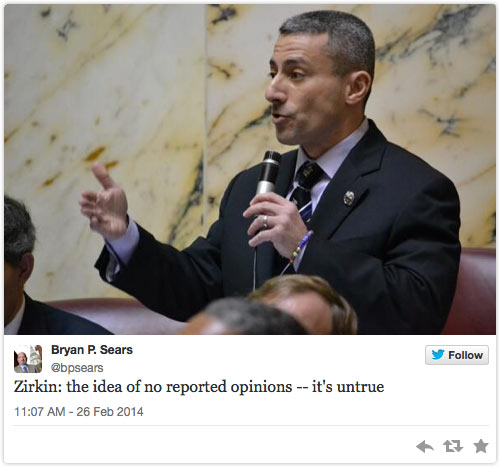
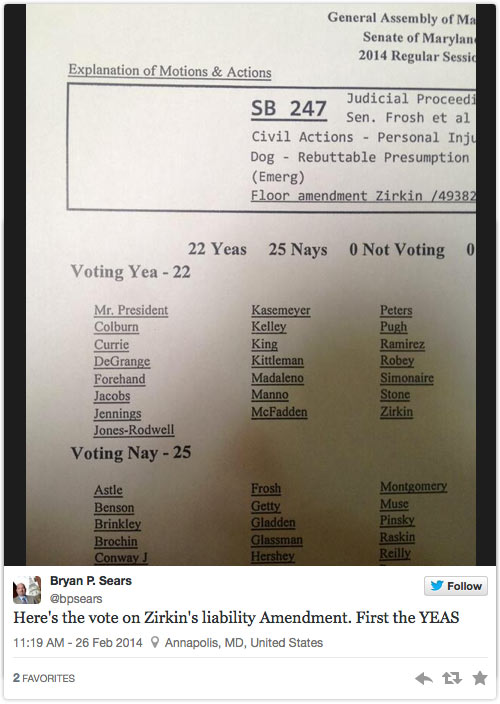
February 26, 2014 - Brian Sears of The Daily Recordlive tweets the Senate floor debate where Sen. Bobby Zirkin attempts to amend the poor "compromise" bill, sponsored by Sen. Frosh, to a strict liability bill (loss 22-25 vote). Zirkin successfully adds an amendment for strict liability when an "at large" dog attacks (win 25-22).
April 8, 2014 - Governor O'Malley signs the "compromise" bill into law that does not provide uniform or adequate justice for Maryland dog bite victims. The governor should have rejected the bill, forcing the two chambers, who had been inching closer together, to draft legislation that is truly meaningful for all dog bite victims.
A Special Thanks to the Good Senators
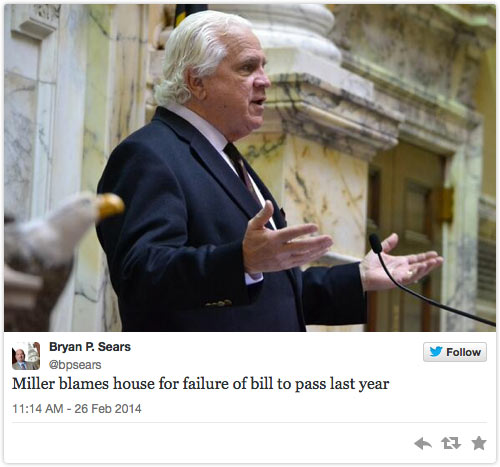
A special thanks goes out to Sen. Bobby Zirkin, the President of the Senate, Thomas V. Mike Miller, Jr., and the other Senators who got very close on February 26 (in a 22-25 loss) to amending Sen. Frosh's poor "compromise" bill to a full and meaningful strict liability standard for all occurrences of damaging bites, not just limited to the meager 20% that involve "at large" dogs.
1With the separation of powers, one branch can change the law. So in this instance, the Court modified the "common law" (which means the Court "made law") and the legislature wrote a new law, a statutory law, setting out what the law will be in Maryland. The Solesky decision was not overturned by the Court, thus other courts around the country can still cite the decision in their own court decisions. 2For readers new to the Solesky case, prior to the Court's ruling, all Maryland dog bite victims were subject to the one bite rule, the "common law" and worst standard, where victims have to prove the dog owner "knew or should have known" of the dog's vicious propensities in order to pursue a civil claim. A documented previous bite by the dog is the easiest way to achieve this, that first bite being "free." The Court could only rule on what was before it, so it modified "common law" by attaching strict liability when a pit bull attacks a person -- no free first bite for pit bulls. The Court's ruling was a signal to the legislature that the one bite rule (developed in the 1600s) is out of touch with modern society and a statutory law needed to be written to better protect all Maryland dog attack victims. Again, legislators should have left the ruling intact and adopted a strict liability statute for all dog breeds. 3
4In the case of Solesky, when the lease for the tenant was renewed, it contained new language (after learning that the tenant had acquired two pit bulls), specifically language (#13) that excluded the landlord from liability if the pit bulls attacked a person. The new language indicated that the landlord was "aware" the dogs could have vicious propensities and was a focal point of the case. 11. Pets: The Lessee is allowed to keep pets that are agreed upon by Lessee and Lessor: 2 pit bull dogs. 13. The Lessee will be civically [sic] and financially responsible for their pets. Should their pet(s) harm anyone, it is the Lessee’s financial responsibility to pay for the damage. The Lessor is in NO Way responsible. 5Though we do not know this until late May 2012, it is learned through legal filings that Tracey died on February 2, 2012 before the Court issued its April decision. A substitution of party was made at that time. 6We specifically state "news articles," as they are supposed to be less bias. Eleven months after the Court issued its ruling, the Sun finally contacted the Solesky family. Think about how obscene that is? The ruling unleashed a firestorm of controversy and the Sun wrote article after article about this controversy month after month, but did not interview the Soleskys for eleven months. It was only during the last few days of the 2013 Regular Session, after it became clear the "compromise" bill was going to fail, that the Solesky family had any value to the Sun. The battle in Maryland was never only fighting against multimillion dollar housing associations (landlords), animal welfare organizations and "heavily" lobbied legislators, it was also always about public opinion and fighting to get our message heard. For the first eleven months, which included two special legislative sessions and one full regular session, "news articles" from the Sun ignored this perspective. There were a few opinion pieces that were supportive of the ruling and notably one powerful column by Dan Rodricks, but these were in the "extreme" minority.
'Ponytail' Excuse UPDATE 05/30/14: In case readers missed Blackfish, a 2013 documentary about a killer whale living in captivity involved in the deaths of three people, most recently a trainer at SeaWorld, you might not fully understand the "ponytail" excuse. This excuse is not a product of Steve Klemetti -- owners of killer dogs rarely have original ideas -- but rather an excuse popularized by SeaWorld after the death of Dawn Brancheau in 2010. Blackfish pulverized SeaWorld's "ponytail theory."1
Pit bull owner:
Klemetti said the day of the attack, his wife, Victoria, was with Morrison, who had looked after the dogs before. When Morrison knelt down to pick up a tennis ball they were playing with, the first thing the dogs went after was Morrison’s ponytail.
“I think what happened is that she had a ponytail and she reached down to get something and one of the dogs said “Hey, this looks like my rope toy” and jumped up,” Klemetti said. - Steve Klemetti, speaking to Opelika-Auburn News
SeaWorld:
The killer whale that drowned a veteran trainer was just curious about her ponytail and dragged her into the water to investigate a new toy, the former head of animal training at SeaWorld Orlando said Friday… It was playful curiosity, Lacinak said, and not a bloodthirsty attack. Brancheau's ponytail was merely a "novelty item" to the whale ...
"It was a novel item in the water, and he grabbed hold of it, not necessarily in an aggressive way," he said. - Thad Lacinak, speaking to CBS News2
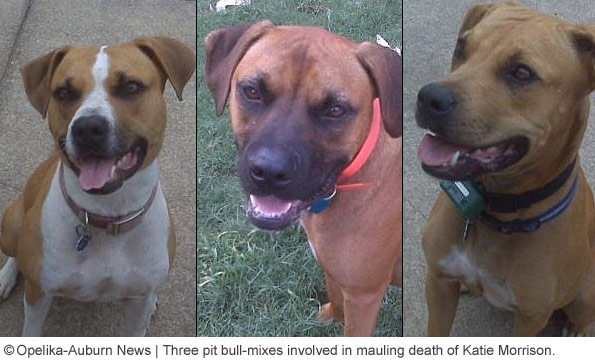
We remind readers that Klemetti's three pit bulls completely scalped 20-year old Katie Morrison right in front of one of their owners, his wife Victoria Klemetti, who was helpless to stop the dogs. Steve Klemetti does not stop with the "ponytail" blame game either. He insinuates that being "down on their level" -- aka Katie bending down to pick up a tennis ball -- is an excuse for his dogs to "go primal" and to "go instinctual," which is why "I never get down on their level," he said.
Finally, as if on "Classic Pit Bull Owner Cue" Steve Klemetti called the brutal attack a "freak incident," despite the fact that pit bulls kill more people than all other dog breeds combined. In the first 101 days of this year, pit bulls maintained an average kill rate of every 9.2 days. Klemetti also claims to cry every time he recalls a touching moment with one of his killer dogs. He regrets his wife's decision to put the three dogs down, "It's like part of your family is gone," Klemetti said.
05/16/14: Attacking Dogs Put Down
On May 15, the Opelika-Auburn Newspublished an alarming news article about the three pit bulls that brutally attacked a 20-year old woman on April 28, peeling off her entire scalp, in front of their owner.3 Katie Morrison died in the hospital due to her severe injuries on May 3. Lee County Sheriff Jay Jones said there is not a state law or local act that mandates putting the dogs down. Further, Jones explained, "the dogs' owner has gone back and forth on bringing the dogs home."
This is not the first time such horrific, pathological behavior has been demonstrated by the owner of a fatally attacking pit bull.
Residents were appalled to learn that the three pit bulls might be returned to their owner. Lee County District 3 Commissioner Gary Long said, "I was shocked that the potential was there for those dogs to go back to the neighborhood." A hearing was held in district court to determine the outcome of the dogs, but the court declined to issue a ruling, citing it had no legal authority to do so. "Absent of criminal activity," Jones explained, at least at this point, the court declined to rule.
The following day, May 16, the Opelika-Auburn News reported that the dogs were put down that evening. The report also named the owners of pit bulls, Steve and Victoria Klemetti of Phenix City. Lee County Sheriff Jay Jones said the owners ultimately chose to have the animals put down. According to a court order, the Klemettis had the option to give the dogs away provided that they inform the new owners of the dogs' violent history and that the Sheriff's Office be notified.
The investigation is ongoing and will be presented to a grand jury sometime in the future.
05/04/14: Scalping Victim Dies
Smiths Station, AL - The Lee County coroner reports that a young woman hospitalized for severe pit bull injuries last week has died. Katie Morrison, 20-years old, was getting acquainted with the dogs, preparing to "watch" the four dogs4 while their owner left town, when three of the dogs, pit bulls, turned on their owner and Morrison. The May 2 WTVM article also noted that Morrison's "critical condition is not improving." She was added to the DogsBite Fatality Watch list at that time.
The dog owner's sister, Billie Mixon, said the two were in the company of the dogs for about three hours but then, "when she bent down to grab the tennis ball, one jumped on, then the other jumped on, and the dogs turned different than they've ever been before."
Neighbors on Lee County Road 504 in the Heather Brooke neighborhood recall what happened next. They said three of the four pit bulls turned on their owner and the visiting 20-year-old woman was nearly scalped. The owner also sustained injuries trying to pull them off.
"I looked over the fence and I saw that lady laying there. What I remember was her head -- there was almost no hair left. The head and the face were covered with blood," said Gabby Witt. - Dante Renzulli, WTVM.com, May 2, 2014
WTVM interviewed several neighbors after the attack. Jodie Marshall said, "Even the animal control officer was frightened. They didn't know how they were going to get the dogs out, they were very aggressive." David Witt said he was not too surprised. "I figured that sooner or later it was going to come down to that because these dogs had previously attacked other dogs in the neighborhood, and it was just a matter of time before they went after a human," Witt said.
Morrison was transported by ambulance to Midtown Medical Center in Columbus and then transferred to Grady Memorial Hospital in Atlanta. She succumbed to her injuries Saturday night. Coroner Bill Harris said she suffered severe head injuries and multiple laceration and puncture wounds all over her body. The dogs' owner voluntarily transported her dogs to animal control and surrendered them after the attack. The dogs remain in the state mandated 10-day quarantine.
1Film response: "Although eye witness accounts and a video of events just prior to the take-down seem to strongly contradict the notion that Dawn was pulled in by her ponytail, it is most important to note that according to SeaWorld’s own Management during courtroom testimony, Tilikum was desensed to ponytails and therefore did not find them a novelty. The brutal nature of the prolonged, aggressive attack and the facts in the autopsy strongly suggest that Tilikum’s behavior was anything but novel curiosity. These facts were internally corroborated by senior level training staff at SeaWorld." See full Blackfish documentary online. See also a review by Ken Brower in National Geographic. 2In April 2014, the U.S. Court of Appeals for the District of Columbia Circuit upheld a federal occupational safety agency's finding against SeaWorld Entertainment Inc. after the death of Dawn Brancheau. 3News articles cite conflicting dates of the initial attack, April 28 and April 30. They also refer to "Monday" of that week, which was the 28th. 4According to an Opelika-Auburn News article, Lee County Sheriff Jay Jones said, "The three dogs that attacked the victim are pit bulls. The fourth, which was not involved in the attack, is of a different breed, Jones said."




 View the DogsBite.org Google Map: