
Central Texas Pediatric Study: Pit Bulls Inflicted the Highest Prevalence and Severity of Dog Bite Injuries (2011-2016)

Study: Injury Prevention Requires "Vigilant Adult Supervision"

central texas pediatric study
A summary of a recent Central Texas pediatric study about dog bite injuries.

View Abstract
Temple, TX - Last fall, the Journal of Pediatric Surgery accepted a study from researchers at Texas A&M University Health Science Center in Temple, Texas. The study was recently assigned to the journal's July 2019 volume. We summarize this powerful study in advance, as critical elements stand out: the number of cases where parental presence was reported (43.6%) and a sudden reversal of gender among pediatric dog bite patients; 57% were girls in this series.

Also last fall, we published two tables summarizing Level 1 trauma center studies characterizing dog bite injuries across major U.S. geographical regions from 2011 to 2018. The majority of them show that pit bulls are inflicting a higher prevalence and severity of injuries than other breeds of dogs. The Central Texas study reports similar findings and echoes results from the pediatric Level 1 trauma center study in Phoenix (Garvey et al., 2015) published by the same surgery journal.

Both pediatric studies report similarities in injury circumstances, the patient's relationship to the dog and that pit bulls accounted for the most severe injuries. In Garvey, pit bulls were responsible in 45.5% of cases with the highest AIS of 3-5 (Abbreviated Injury Scale) and inflicted 38% of all head, neck or face bites. In the Central Texas study, pit bulls were the most frequently identified breed, 36.2%, and were also the "most commonly identified breed to have caused major injury."

Pediatric Dog Bite Injuries in Central Texas

Pediatric Dog Bite Injuries in Central Texas, by J.T. Abraham and M. Czerwinski, Journal of Pediatric Surgery, July 2019 [2018 Oct 31, Epub]

Results: One-hundred and two patients met the inclusion criteria. The mean age was 5.84 years, and 43.1% were preschool-aged (2–5 years). Parental presence was reported in 43.6% of cases, and most attacks occurred in the evening (46.8%). Injuries often involved the head-neck region (92.1%), and 72.5% were of major severity. Pet dogs were responsible for 42% of injuries, and pit bull was the most-identified breed (36.2%). Most injuries occurred while the child was at home (57.8%) and was petting or playing with the dog (28.4%). Intervention in the operating room was required in 34.3% of patients. Major injury was more likely to require operative intervention (p = 0.015) but was not associated with patient age, sex, pet status, or the need for hospitalization.


Methods and Patients

A retrospective review of the pediatric trauma registry was conducted for this study. Patients who were treated at [blinded] emergency department in Texas from October 2011 to October 2016 after sustaining a dog bite injury were evaluated. Inclusion criteria were persons ≤ 18-years old who sustained a dog bite injury and were presented to the emergency department directly or as a transfer from a regional center for continued care. 102 patients met these inclusion criteria.

Of the 102 patients, ages 3 days to 16-years old, 57% were female. The majority of patients were pre-school aged children, 2-5 years old.

The mean age was 5.84 years and pre-school aged children, 2-5 years old, where the highest afflicted group, 43.1%, followed by children ages 6-12 years old, 41.2%. Infants and toddlers (< 2 years) accounted for 10.8% of injuries. In 43.6% of cases, a parent was present at the time of injury; not present in 30.7% of cases and in 25.7% of cases supervision was unreported. 92.1% of cases involved injury to the head-neck regions and 72.5% of injuries were of "major severity."

In contrast to years of pediatric studies -- both large-scale and small -- showing that boys are the most predominant dog bite victims, the Central Texas study showed that 57% of patients were girls. (We saw a similar sudden gender reversal in our 2018 dog bite fatality report. For the first time ever, among ages 0-9, girls were the most predominant, 80%, 12 of 15 victims). The Garvey study also cites a 2013 facial fracture study of 17 patients where girls were the majority, 53%.

The Central Texas study findings show that the evening (5:00 pm to 8:59 pm), accounted for nearly half of all injuries, 46.8%. Afternoon followed (noon to 4:59 pm; 28.7%), night (9:00 pm to 4:59 am; 13.8%), and morning (5:00 am to 11:59 am; 10.6%). Notably, December had the highest percentage of injuries, 14.7%. The spring months (March to May) accounted for the most injuries, 31.4%. Followed closely by winter months (December to February) with 29.4% of injuries.

At least two other pediatric dog bite injury studies (from 1998 and 2000) showed that evening hours accounted for the majority of injuries.1

Though some of these findings are known from previous studies, they are extremely significant. The majority of patients were familiar with the dog, 57.8% of injuries occurred while the child was at home, a parent was present in 43.6% of cases, 92.1% of cases involved injuries to the head-neck region and winter months accounted for 29.4% of injuries. Recall that National Dog Bite Prevention Week, which signals the start of the traditional dog bite season, is held in mid April.2

Major Injuries and Dog Breeds

72.5% of patients suffered "major injury," a classification based on the likelihood of operative intervention or that an impairment of physical abilities would occur. Included in these injuries were 6 cases of craniofacial fractures (a high rate, 5.9%, and comparable only to the 2015 Garvey study, which had a 4.6% facial fracture rate) and 2 cases of major vascular injury.3 There were no fatalities in the Central Texas study, and injury severity was not associated to the patient's gender.

A total of 80 dogs were identified by breed in 75 encounters, 73.5% of cases. Pit bulls inflicted the highest prevalence of injuries, 36.2%, over 3 times more than the next breed, Labrador retrievers, inflicting 10%. Pit bulls were also the most frequently identified breed in causing major injury. Pet dog(s) from the child's immediate family was responsible in 41.4% of cases. Nonpet dog(s) belonging to a relative, 19.2%, or a friend, 17.2%, made up the majority of the remaining cases.

The Central Texas study shows that about 60% of cases involved family dogs belonging to the child's immediate and extended family.

The discussion portion of the Central Texas study focuses in part on two frequent scenarios that result in attacks. In the first scenario, dog owners mistakenly "assume their dogs can be trusted in all circumstances." In the second scenario, parents are not closely monitoring benign interactions, particularly during the evening hours, such as a child playing with or petting a dog, which was the most common injury scenario in this study, 28.4%, followed by "no initiated interaction," 13.7%.4

"Familiarity with a dog should not be considered a preventative measure," states the Central Texas study, "as most victims are familiar with the attacking dog." A shared finding of the 2015 Garvey study, which stated that, "dog familiarity did not confer safety." In both studies, pit bulls were also singled out for requiring the longest hospital stays.5 The Central Texas study calls on "vigilant adult supervision, and a zero-tolerance policy," as an injury prevention recommendation.

Lastly, because the Central Texas study was blinded, authors could not determine the rate of pit bull attacks based on prevalence. The Garvey study, however, could. Phoenix Children's Hospital is located in Maricopa County. Garvey cites a 2012 news report of county records showing that pit bulls accounted for 6.25% of the licensed dog population. Despite this, pit bulls accounted for 39% of all injuries, 45.5% of cases with the highest AIS and 38% of all head, neck or face bites.6

Morbidity of Pediatric Dog Bites: A Case Series at a Level One Pediatric Trauma Center

Morbidity of Pediatric Dog Bites: A Case Series at a Level One Pediatric Trauma Center, by Garvey EM, Twitchell DK, Ragar R, Egan JC and Jamshidi R, Journal of Pediatric Surgery, February 2015;50:343-6.

Of 650 dog bite incidents, 282 met the criteria for inclusion in the trauma database. Median age was 5 years (range, 2 months to 17 years) and 55% (154/282) of patients were male. Pit bulls were most frequently responsible, accounting for 39% (83/213) of incidents in which dog breed was documented. Fifty-three percent (150/282) of dogs belonged to the patient's immediate or extended family...

Among the 11 patients with the highest AIS (3–5), Pit bulls were responsible in 45.5% (5/11) of cases, followed by mixed breeds in 18.2% (2/11) of cases. Pit bulls were also responsible for 38% (11/29) of all head, neck or face bites...

Dog familiarity did not confer safety, and in this series, pit bulls were most frequently responsible. These findings have great relevance for child safety.


Summary

Our nonprofit will continue to monitor pediatric dog bite injury studies from regions across the U.S. The Central Texas and Garvey studies (south and southwest regions) point to family dogs as the primary attackers of children, as do other pediatric studies dating back to 2002.7 Both also note an elevated attack rate in the month of December. The gender role reversal in the Central Texas study of 57% girls is the first we have seen in a pediatric study population of 100 or more.

What should alarm dog-owning parents is that parental presence was reported in 43.6% of cases. Nearly 60% of the attacks occurred in the child's home and 46.8% occurred during the evening. Further, "Medium- to large-sized dog breeds, particularly pit bulls, can cause significant injury to the head and neck region, necessitating medical care at a specialized center, and should not be under the responsibility of amateur or irresponsible owners," the Central Texas study concludes.
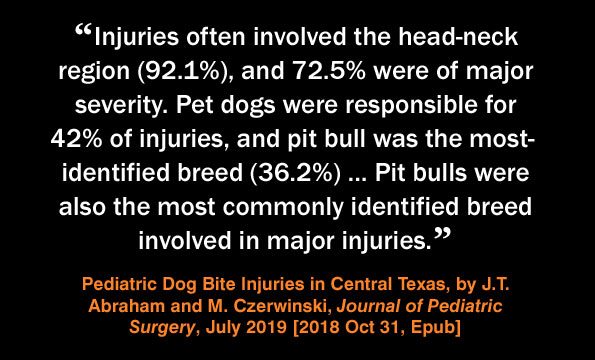
meme: central texas pediatric study

Excerpt from peer-reviewed medical study: Pediatric Dog Bite Injuries in Central Texas (2019)

1Evening hours accounting for the majority of injuries was also reported in (Bernardo et al., 2000) 54% and (Bernardo et al., 1998) 41%. A period when parental supervision may be lowered due to household activities, making dinner and more. Unfortunately, this has been documented in research for two decades now and the Central Texas study still shows similar findings. During (Bernardo et al., 2000), pit bulls were the most common breed identified with only 19%. The Central Texas study shows a near doubling of this percentage since.
2In Garvey, the most common months of injury were July and November, during which 24% of injuries occurred. August and December followed, during which 20% of injuries occurred. In our nonprofit's research of fatal dog maulings over the last 14 years (2005 through 2018, which combines children and adult age groups), May and November are the most common months (21% of deaths), followed by August and December (20% of deaths).
3Pediatric studies often report a facial fracture rate of 1 to 1.5%, including (Saadi et al., 2018), a large-scale study.
4Circumstances of injury were known in 74 of 102 cases. The percentages provided (as well as the 28.4% stated in the abstract), reflect a comparison to the overall 102 patients. So 28.4% (29 of 102) of cases involved the child playing with or petting the dog, and 13.7% (14 of 102) of cases involved "no initiated interaction."
5Within the "major injury" section, the Central Texas study states, "Two patients required monitoring in the intensive care unit (lengths of stay: 1 day and 3 days) after sustaining major injuries at home by pet pit bulls." The longest stay in the Garvey study was 25 days after a boy was attacked by a pit bull. Garvey also reports, "The high incidence of operation, fractures, and external genitalia wounds raise the possibility of increased severity of injury in our region compared to others. It may also relate to the high percentage of pit bull involvement in this cohort."
6 The Garvey study examined 282 dog bite patients evaluated at Phoenix Children's Hospital from October 1, 2007 to December 31, 2013. The authors cite a news article, "Dog Registration in Maricopa County. Dog Licenses by Zip Code," published by AZ Central in 2012 for their data. The study states, "In 2008, there were 122,017 licensed dogs in Maricopa County, the most populous county in Arizona. Pit bulls accounted for 6.25% (7,632/122,017) of the licensed dog population, only the seventh most popular breed. Labrador retrievers were the most popular breed accounting for 25.7% (31,377/122,017) followed by German shepherds at 13.8% (16,881/122,017)."
7In (Kaye et al. 2009) 69% of cases involved dogs known to the injured children. "This suggests that familiarity with a dog is not a safeguard against an attack," states the study. Kaye cites a 2002 pediatric study with similar findings.

Related articles:
09/28/18: Level 1 Trauma Center Studies Characterizing Dog Bite Injuries (2011-2018)
09/20/17: Which Dog Breed has the Highest Prevalence and Severity of Injuries in Recent ...
10/10/16: Level 1 Trauma Center Studies Characterizing Dog Bite Injuries (2009-2016)
05/22/11: Texas Doctors Produce Study: Mortality, Mauling and Maiming by Vicious Dogs


2019 Dog Bite Fatality: Pit Bulls Implicated in Attack that Killed Woman in Costco Parking Lot

costco parking lot attack - Crystal Pearigen
Crystal Pearigen, 36, was found dead in a Costco parking lot after being mauled by dogs.

Family Speaks Out
UPDATE 07/03/19: The family of a woman found dead in a Costco parking lot on June 16 has been located. Crystal Pearigen, 36, was killed by three dogs -- two pit bulls and a mixed-breed. KGET posted this update on June 25, along with a YouTube video. Crystal led a tragic life, including the loss of her mother, Rhonda Pearigen, who was murdered in 1997. After her mother's homicide, Crystal interacted with CPS, foster care and was later diagnosed with schizophrenia.

When Crystal's name was released by the Kern County coroner's office, the paternal grandmother of Crystal's only child came forward. "All I could think about was how hard her poor little life was -- and then to die like this. It has killed my heart," Jennie Greene said. Greene knew Crystal from when she was a teenager and went to school with Greene's son, who she later had a child with. Greene eventually took over the care of this child, Michael Keen, and raised him as her own.

In the video, Greene painfully reflects upon what the coroner's office told her. "The lady at the coroner's office said that she was mauled and killed -- attacked by dogs," Greene recalled. "And, that Michael would have to come sign papers when we figured out what we were doing. And she said that the coroner absolutely recommended absolutely no viewing of any kind. 'Please, don't put yourself through that -- or your family,'" Greene told KGET while holding back tears.

Michael, who is now 18 and still in school, is trying to raise funds to help lay Crystal to rest.

06/24/19: Mauling Victim Identified
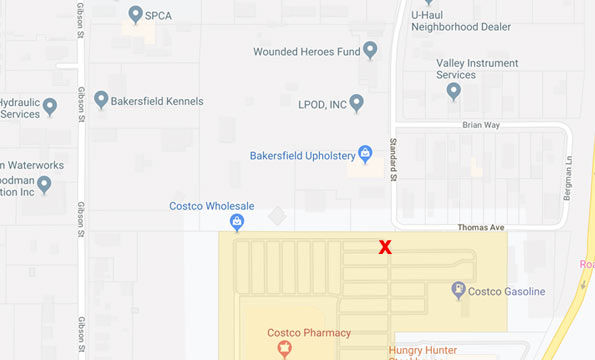
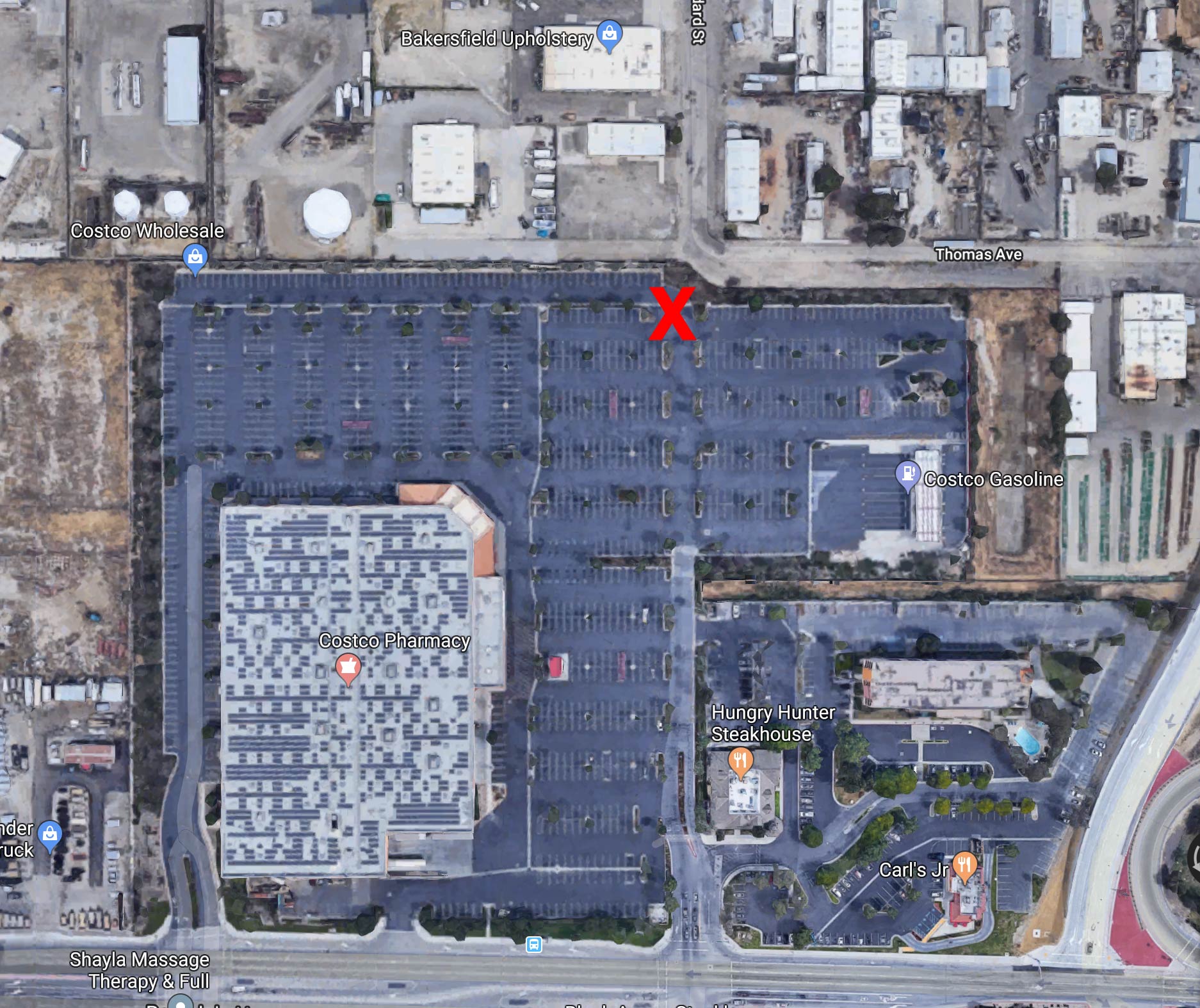
Coroner officials have identified the woman found severely wounded and dead in a Costco parking lot on June 16. Crystal Pearigen, 36-years old, was discovered with "obvious" signs of trauma at about 6:00 am. Police confirmed that three dogs -- two pit bulls and a mixed-breed dog -- attacked Pearigen. The vicious attack began in a commercial area adjacent to Costco shared by several businesses. As the attack continued, Pearigen crossed into the Costco lot, where she later died.

The cause of death was determined to be "multiple injuries," according to the county corner's office. The manner of death was ruled an accident.

Police confirmed that two of the dogs -- a pit bull and mixed-breed -- belonged to a nearby business and escaped prior to the attack. Police have not named the dogs' owner or the business. The third dog, another pit bull, was a stray. Surveillance footage captured by another nearby business showed two of the three dogs involved in the attack, as well as a woman walking alone that may be the victim. Police have been unable to locate any family members of Pearigen.


06/17/19: Woman Discovered Dead
Bakersfield, CA - Authorities confirmed that three dogs killed a woman in Northwest Bakersfield this weekend. According to Bakersfield Police spokesman Nathan McCauley, a pit bull and a mixed-breed dog escaped from a nearby business before the attack and the third dog, another pit bull, was a stray. The victim, who is in her 30s or 40s, is a Bakersfield resident. Police have not released her identity. A bystander discovered her body just before 6:00 am Sunday morning.

An earlier report by the same news group, 23 ABC, said the attack happened in the Costco parking lot off of Rosedale Highway. The woman's body was discovered with significant and "obvious" signs of trauma. At that time, the Kern County Coroner's Office was still determining the cause of death, though police suspected it was a fatal dog mauling. Animal control officers located and impounded all three dogs. Investigators are still seeking witnesses of the deadly attack.

More details were published in Bakersfield.com. McCauley said the business owner surrendered his two dogs to police. One of his dogs was already euthanized for being outwardly violent, McCauley said. Neither the man's nor the business' name was released. The remaining two dogs are being held at Bakersfield Animal Care Center. Both are also expected to be euthanized. The identity of the victim, described as a transient, will be released by the coroner's officer, police said.

Late Evening Updates

Late Monday, 23 ABC published surveillance video provided by a nearby auto shop showing one of the three dogs, which officials confirmed attacked the woman. Police believe the attack started in a commercial area adjacent to Costco shared by several businesses. As the dogs continued to attack, the woman tried to escape through a fence surrounding the Costco parking lot that had previously been slashed. She was discovered dead inside the Costco parking lot Sunday morning.

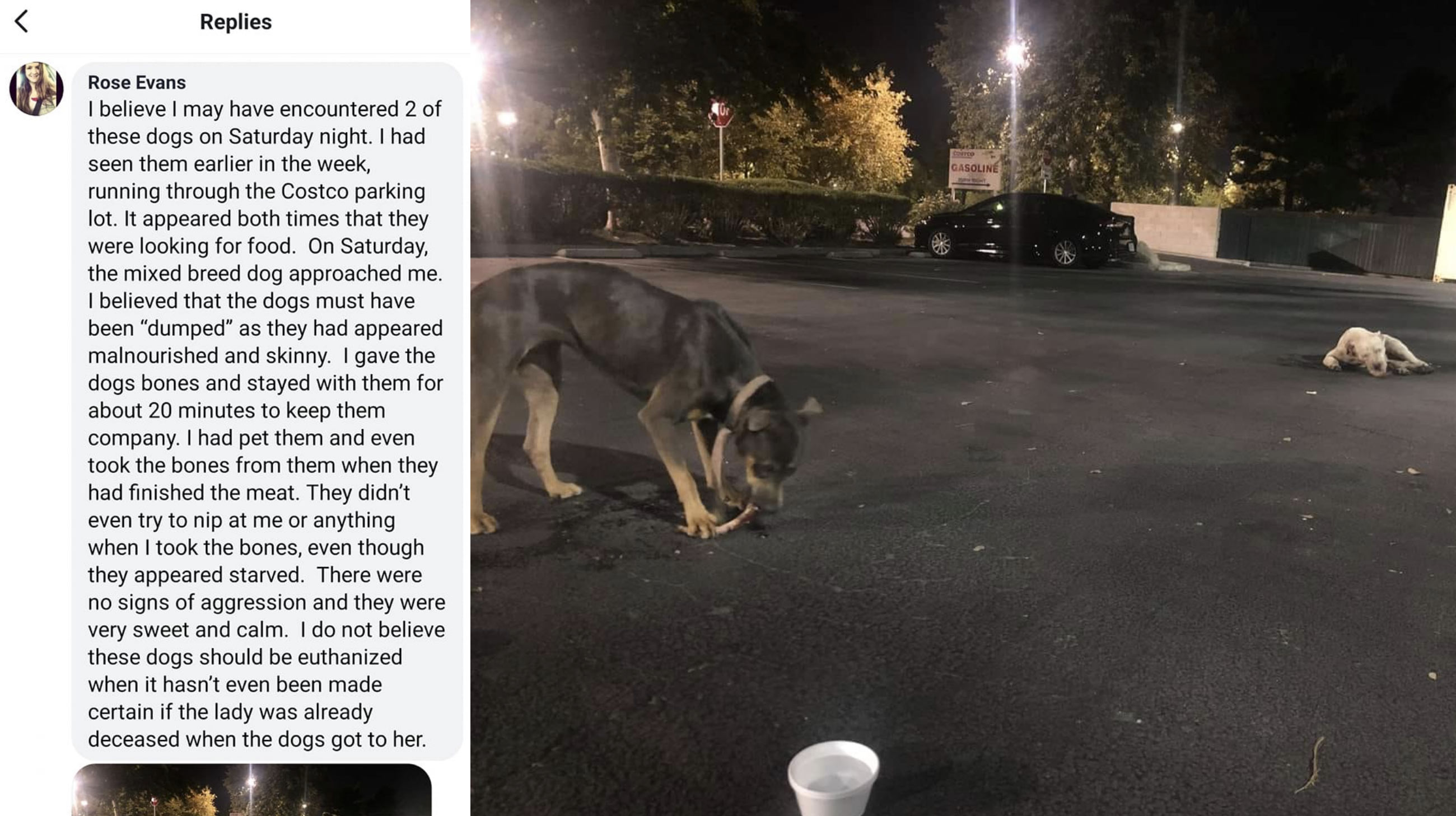
Jaime Camorlinga, the owner of Central Valley Performance auto shop who provided the footage, told 23 ABC he'd seen the two dogs before. "I've seen those two particular dogs walk around once in a blue moon," Camorlinga said. "I never thought about them as dangerous or anything." He also addressed the fence line surrounding the Costco parking lot. "I think that people cut that fence to have easy access to cross, instead of going all the way around [the parking lot]," Camorlinga said.

Camorlinga later released a second surveillance video showing two of the three dogs, along with footage of woman walking alone that may be the mauling victim. "She's somebody's daughter for sure," he said. "That's got to be heartbreaking for the family." KBAK arrived to the area just after Costco fixed the slashed fence. "They patched it yesterday and they reopened it again -- it was reopened this morning," Camorlinga said. People are cutting through to get to Rosedale Highway.


Other nearby businesses include Bakersfield Kennels, Bakersfield SPCA, auto repair shops, a trucking company, a distribution company, a waterworks company, an upholstery shop and more.

costco parking lot - pit bulls kill woman

From left: slashed fence, surveillance footage and commenter who previously saw the dogs.

costco parking lot attack - pit bulls kill

Businesses near a Costco parking lot where dogs fatally attacked a woman in Bakersfield.

map iconView the DogsBite.org Google Map: California Fatal Pit Bull Maulings.
Related articles:
03/29/19: 2019 Dog Bite Fatality: Joshua Tree Woman Killed by Four Pet Pit Bulls Belonging...
02/18/19: 2019 Dog Bite Fatality: Woman in Anza Pit Bull Attack Dies of Injuries After Weeks...


Baseline reporting requirements:
Law enforcement departments across the United States should release consistent "baseline" information to the media and the public after each fatal dog mauling, including these items.

2019 Dog Bite Fatality: Man Dies After Saving 5-Year Old Daughter from Dog Attack In Iowa

dog attack iowa - robert joseph quick
Robert "Joey" Quick died after saving his daughter from a dog attack in Iowa.

Mother Mourns Son
Fort Madison, IA - On June 1, the Lee County Sheriff's Office issued a news release stating that on May 31, the Fort Madison Police Department responded to a dog attack at 102 Avenue C. Upon arrival, they found a large dog attacking a man, lying on his back, in the front yard of the home. "The dog was very aggressive and did not release the man," states the release. "The officers on the scene did have to discharge a weapon to dispatch the animal to stop the attack."

After first responders rendered aid to the adult male victim, they found 33-year old Robert Joseph Quick Jr., of Dallas City, Illinois, lying in the doorway, also injured from the dog attack. Quick told officers to help his 5-year old daughter first, who had been bitten in the face by the dog. They located his daughter and rendered her first aid. Quick was later pronounced dead at Fort Madison Community Hospital, "after tremendous efforts to save his life on scene" were unsuccessful.

A GoFundMe created for Quick's funeral costs, states that he had a heart attack at the scene and could not be revived. As of Friday, June 7, no cause of death has been released by the coroner's office. His mother, however, Deb Newman, recently shed more light on his dog attack injuries. There were injuries to his jugular vein in the left side of his neck, his nose was "ripped open" and more. The severity of Quick's injuries classifies him as a dog bite fatality in our data collection.

"(There were) bites in Joey's jugular vein in the left-hand side of his neck, and then there was bites in his right arm," Newman said she was told. "His nose was ripped open, he had blood coming out his ears. There was a bite-mark on his temple, and there was bite marks on his hands. - Des Moines Register, June 7, 2019

Earlier news reports stated that one of the male victim's injuries were "superficial." If the coroner eventually makes that determination about Quick, his death will not be included in our fatality statistics. Otherwise, we include all cardiac arrest cases when the victim also suffers severe dog bite injuries. This method of classification has been true since we began collecting data in 2007. Police described the dog, which attacked two grown men and one child, as a brown male boxer.

According to Newman, Quick had recently moved into his mother's home in Dallas City, Illinois. His estranged wife and their two daughters lived about eight miles away across the Iowa border in West Point. On May 31, Quick brought two of his four children with him to retrieve an inoperable car at 102 Avenue C in Fort Madison. Newman said his daughters went inside the home and were attacked by a "very big" boxer. Quick rushed into the home to save his two young daughters.

"Joey ran into the house, and I guess he was the only one strong enough to pull the dog off," Newman said, recalling what she was told by a witness who was dog-sitting the animal in the home. "Joey threw the dog out of the house." - Des Moines Register, June 7, 2019

The dog not only went after Quick and his daughters, it attacked a 49-year old man who lived at the home. Persons at the home had been dogsitting the animal, according to police. Police have not identified anyone living at the home, nor the owner of the dog that attacked three people, sending all three to the hospital. "It's gonna take a long time to come to terms with it. My son is no longer alive because of that dog," Newman told the Des Moines Register. "Yeah, I'm angry."

Newman also said, referring to the family dogsitting the animal, "They haven't even apologized. They keep saying how nice the dog was, they can't believe it was mean." Quick's 5-year old daughter, who suffered dog bite injuries, "wasn't told (about her father's death) right away," Newman said. "She was finally told the other day that her daddy's sleeping in heaven. It's kind of hard to tell a young girl, and they don’t want her to feel guilty, so he's sleeping in heaven.”

Related articles:
02/28/19: 2019 Dog Bite Fatality: Greenville Woman Severely Mauled by Her Own Dogs...
01/18/18: Persistent 'Wild Animal' Theory Finally Derailed, Elderly Man was Killed by a Pack...


Baseline reporting requirements:
Law enforcement departments across the United States should release consistent "baseline" information to the media and the public after each fatal dog mauling, including these items.

Delta Passenger Repeatedly Attacked in the Face by a Large "Support" Dog Sues Airline and the Owner of the Dog

The Complaint Against Delta - Analysis & Discussion

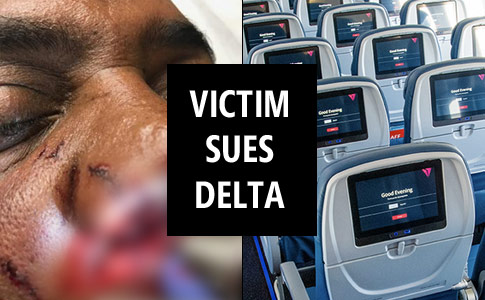
Complaint against delta - dog attack victim sues Delta

On June 4, 2017, after Marlin Jackson boarded Delta Flight 1430 in the Atlanta Hartsfield-Jackson Airport, he was repeatedly attacked in the face by a large "support" dog seated on a man's lap.
On May 24, 2019, Jackson sued Delta Air Lines and the owner of the dog in Fulton County state court. The complaint details the allegations against the two parties and asks for a jury trial.
Our report discusses the legal complaint and is divided into four parts: The Complaint Against Delta, The Complaint Against the Dog's Owner, Questions and Discussion; and a Summary.

Jackson v. Delta et al.
Atlanta, GA - A man viciously attacked in the face by an alleged "support" dog onboard a Delta aircraft in 2017 has sued Delta Air Lines and the owner of the dog. A lawsuit filed in Fulton County state court alleges that Marlin Jackson was in a window seat when a large dog seated on the lap of a man next to his repeatedly attacked his face while pining him against the window of the plane. This occurred just after Jackson asked the owner multiple times, "Is your dog going to bite me?"

Leading Up to the Complaint

After this attack, we wrote a special report detailing the widely abused loophole in three federal acts pertaining to service and emotional support animals (ESA); the unprovoked attack on Jackson by a large unrestrained "support" dog onboard Delta Flight 1430; the case against Delta Air Lines and competing public interests; the inconsistent federal and airline safety policies in regards to service animals and ESAs; and an addendum about psychiatric service animals.

Seven months after Jackson was attacked, Delta announced an increased screening process for in-cabin service animals and ESAs. Delta's "enhanced requirements" included requiring a signed Veterinary Health form, verifying basic vaccinations, and a signed Confirmation of Animal Training form declaring, "this animal has been trained to behave in a public setting" and that "if my service animal acts inappropriately" the animal can be denied boarding or removed from the aircraft.

In July 2018, Delta banned pit bull-type dogs as service and support animals and limited ESAs to one per person. "We must err on the side of safety," Delta said in a statement. "Most recently, two Delta employees were bit by a pit bull traveling as a support animal last week. We struggled with the decision to expand the ban to service animals," but determined that "untrained, pit bull-type dogs posing as both service and support animals are a potential safety risk," Delta stated then.

In December 2018, Delta announced that ESAs would no longer be allowed on flights over eight hours and banned alleged service and support animals under the age of four months on all flights. In April 2019, Delta updated its forms for passengers traveling with ESAs or psychiatric service dogs (PSAs) by adding one new form, the "Acknowledgement Form," as well as by beefing up its existing three forms by adding new declarations and animal specific details to attest to.

One new declaration pertains to the size of ESAs and PSAs: "I am not aware of any reason that this animal would be too large or heavy to be accommodated under the seat or within my foot space onboard a typical aircraft."

The other new declaration pertains to liability: "I assume full responsibility for the behavior of this animal ... I understand that I will be expected to reimburse Delta or its passengers for any loss, damage or expense resulting from any misbehavior by my animal." - Delta Confirmation of Animal Training form, April 2019

Aspects About the Complaint

Because this "detail" carries significance in the often-abused loophole in the Air Carrier Access Act (ACAA), we start by pointing out that according to Delta, the estimated 50-pound dog that attacked Jackson was a psychiatric service animal (PSA) not an ESA. In terms of airline requirements at that time (and still today) PSAs fall under the same flying requirements as ESAs. Delta provided this information in their public comments to the Department of Transportation in July 2018.

"In June 2017, a Delta passenger required 28 stitches after being attacked by a psychiatric service dog sitting on its owner's lap. We recently had another incident in June 2018 where an emotional support dog bit a flight attendant on the face, and then bit a customer service agent sent to resolve the situation." - Delta Air Lines public comments to DOT, July 10, 2018

Also, the Delta policies that were in place when Jackson was attacked are the main subject of this complaint. "The attack on Mr. Jackson would not have happened had Delta enforced their own pre-existing policies concerning animals in the cabin," Jackson's two attorneys, J. Ross Massey and Graham Roberts of Alexander Shunnarah and Associates said in a written statement. However, the complaint also claims that more measures by Delta "were feasible at the time."

The Complaint Against Delta

On June 4, 2017, at approximately 11:30 am, Jackson boarded Delta Flight 1430 in the Atlanta Hartsfield-Jackson Airport. He had been assigned a window seat in the 31st row. The complaint then spells out the escalating violent attack. The dog's owner, Ronald Kevin Mundy, Jr., then a 24-year old Marine Corps member, could not stop his dog from attacking, nor did Mundy heed the warnings Jackson asked him multiple times before the attack: "Is your dog going to bite me?"

The Complaint Alleges

"Upon approaching the three (3) seat row, Mr. Jackson encountered Defendant Mundy in the middle seat with his large dog attempting to sit in his lap. The animal was so large that it encroached into the aisle seat and window seat.

Despite Defendant Delta's stated policy for larger animals, to receive special seating accommodations onboard, Delta assigned Defendant Mundy and his large dog, a middle seat in the thirty first (31st) row.

Further, Defendant Delta's published policy states that animals, such as Defendant Mundy's dog, would be secured on the floor; however, Defendant Delta allowed the large animal to remain in Defendant Mundy' s lap while Delta employees passed through the area in open disregard of said policy.

[--snip--]

Prior to taking his assigned seat, Mr. Jackson inquired of Defendant Mundy if the animal would bite. Defendant Mundy put his arms around the animal and indicated that it was safe for Mr. Jackson. As such, Mr. Jackson tentatively proceeded past Defendant Mundy and the animal and took his seat next to the window.

While Mr. Jackson was securing his seatbelt, the animal began to growl at Mr. Jackson and shift in Defendant Mundy's lap. Again Mr. Jackson asked if the dog was safe and Defendant Mundy again assured him that Mr. Jackson would be safe.

Suddenly, the animal attacked Mr. Jackson's face, biting Mr. Jackson several times while pining him against the window of the airplane.

The attack was briefly interrupted when the animal was pulled away from Mr. Jackson. However, the animal broke free and again mauled Mr. Jackson's face.

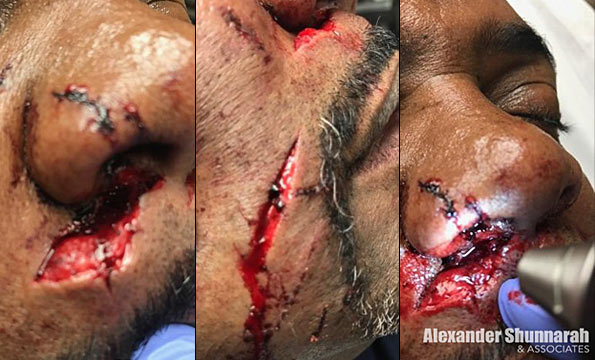
The attacks caused extensive facial damage including deep lacerations and punctures to the nose and mouth. In fact, Mr. Jackson bled so profusely that the entire row of seats had to be removed from the airplane." - Jackson v. Delta et al.

The complaint then lists the damages to Jackson, including that he suffered, "numerous lacerations and punctures to the face and upper body requiring twenty eight (28) stitches" and "permanent injury, scaring, and loss of sensation to the affected areas of his face." Jackson also endured "severe physical pain and suffering" along with sustaining loss of income and loss of life enjoyment. "His entire lifestyle has been severely impaired by this attack," states the complaint.

Allegations of Negligence

As we start to discuss the allegations of negligence against Delta, recall that the Federal Aviation Administration (FAA) and Delta restrict "lap infants" to under the age of two (about 30-pounds). Any child over this age is required to have its own seat. The FAA also recommends a government-approved child safety restraint system or device for young children instead of your lap because, "Your arms aren't capable of holding your child securely, especially during unexpected turbulence."

According to FAA regulations, the placement of lap-held service animals is reserved for service animals that need to be in a person's lap to perform a service for a person with a disability and "may sit in that person's lap for all phases of flight," provided that the "service animal is no larger than a lap-held child." Otherwise, service animals must be stowed underseat within the person's foot space or re-accommodated to a seat with more room if the service animal is larger.1

Count 1. Allegations of Negligence Against Delta

Count 1 of the complaint outlines why Delta breached the standard of care by failing to protect Jackson from reasonably foreseeable harm. "The harm of large, untrained, and unrestrained animals in the cabin of an airplane," states the complaint. Moreover, Delta "knew or should have known that subjecting passengers and animals to close physical interaction in the confined, cramped, and anxious quarters of the cabin, presented a reasonably foreseeable harm."

"Despite what Defendant Delta knew or should have known, it assigned Mr. Jackson a seat on an airplane confined between the window of the cabin on one side and a large animal without verified training on the other. Further, Delta allowed the large animal to encroach the space of others from the lap of its owner instead of being securely positioned on the floor." - Jackson v. Delta et al.

Count 1 also spells out how Delta violated their own policies and procedures intended to regulate animals traveling within the passenger cabin. This is the most irrefutable part of the complaint from our perspective -- Delta cannot skirt violating their own safety policies. "These safety policies, which were posted publicly for the protection of and reliance by all airplane occupants, serve as illustrative evidence of the standard of care and were violated as follows," states the complaint.

"Although Defendant Delta's policy states that 'no animals are allowed to occupy seats...' and that animals are, 'expected to be seated in the floor space below [your] seat', Delta allowed the large animal which attacked Mr. Jackson to remain in Defendant Mundy's seat during the boarding process;

Although Defendant Delta's policy states that with regards to 'larger service animals...[Delta] may need to re-accommodate...if the animal encroaches on other passengers', Delta failed to re-accommodate the large animal from its position in the middle seat, despite the animal, due to its size, noticeably encroaching the seats beside it;

Although Defendant Delta's policy states that Emotional Support Animals (hereinafter, 'ESA') 'must be trained to behave properly in public settings as service animals' and 'a kennel is not required' if the ESA is 'fully trained and meet(s) the same requirements as a service animal', Delta failed to require a kennel for the large animal and/or failed to verify that the large animal, allegedly an ESA, was trained and met the same requirements as a service animal." - Jackson v. Delta et al.

Count 2. Allegations of Negligence Against Delta

Count 2 of the complaint addresses hiring, training and employees. Delta was "negligent in hiring, training and supervising its employees working on the premises," alleges the complaint. Delta and its employees knew or should have known before and during the boarding process the animal would be on the plane, "thus presenting Delta's employees with numerous opportunities to evaluate the animal and take reasonable measures to ensure the safety" of its passengers.

"However, Defendant Delta's employees, who were in the area prior to the attack, failed to act reasonably in preventing the attack, including but not limited to, by failing to enforce Delta's own policies noted above. As such, Defendant's Delta's negligence in hiring, training and supervising its employees resulted in the vicious attack on Mr. Jackson." - Jackson v. Delta et al.

The Complaint Against Mundy

The allegations against Delta are re-alleged against Mundy along with several others, including that Mundy "knew or in the exercise of reasonable care, should have known that his large animal was foreseeably dangerous, especially when confined to the cramped and anxious quarters of the passenger cabin of an airplane," states the complaint. Finally, and horrifically, just after Mundy repeatedly assured Jackson his dog was safe, the dog viciously attacked him in the face.

"Subsequent to the animal's aggressive display of behavior, Mr. Jackson inquired of Defendant Mundy whether the animal was safe and/or would bite, at which time Defendant Mundy voluntarily undertook the responsibility for Mr. Jackson's safety by assuring Mr. Jackson that the dog was safe while physically securing the animal.

Subsequent to the initial assurance by Defendant Mundy, Mr. Jackson proceeded into the row and took his seat by the window. However, the animal's behavior became even more aggressive prompting Mr. Jackson to once again question Defendant Mundy regarding the likelihood of the animal to bite, only to be assured again that the animal was safe.

Mr. Jackson relied on Defendant Mundy's undertakings, prior to entering the row and then again prior to fastening his seatbelt, however Defendant Mundy failed to secure his animal and therefore was negligent under the principle of voluntary undertaking." - Jackson v. Delta et al.

Questions and Discussion

Discussion About Delta

Woven into the complaint are multiple claims of failure to verify training. "Delta took no action to verify or document the behavioral training of the large animal such as, but not limited to, requiring signed documentation that the animal is trained," states the complaint, and Delta "failed to verify that the large animal, allegedly an ESA, was trained and met the same requirements as a service animal." These measures were "feasible at the time but were not in effect until after this attack."

In other words, why weren't Delta's "enhanced requirements" in place to prevent Jackson's attack? Nine months after his attack, Delta began requiring passengers with ESAs and PSAs to sign a Confirmation of Animal Training form declaring, "I confirm that this animal has been trained to behave in a public setting and takes my direction upon command." Also, "I understand that if my service animal acts inappropriately" it can be denied boarding or removed from the aircraft.

When Delta published their comments to the Department of Transportation (DOT) in July 2018, they stated (pages 15-16) that DOT Guidance allowed for behavioral attestations because the key factor in "determining whether an animal presents a direct threat to others or a significant threat of disrupting operations" is to determine whether it has been properly trained and that "attestation forms are fully consistent with existing DOT's service animal regulations and Guidance."2

"In January 2018, when Delta announced modified procedures for bringing an ESA into the aircraft cabin, it added a requirement that those traveling with ESAs attest that their animal is trained to behave in public. As recognized by DOT Guidance, the key factor in determining whether an animal presents a direct threat to others or a significant threat of disrupting operations is whether it has been properly trained ... While behavioral attestation forms are fully consistent with existing DOT's service animal regulations and Guidance ... - Delta Air Lines public comments to DOT, July 10, 2018

While the complaint largely focuses on Delta's failure to comply with its existing safety policies, the complaint also sets forth that methods to verify training (attestations) were feasible when Jackson was attacked, but were not in effect until afterward. Delta's comments also provided statistical data about the number of pet "incidents" and "biting incidents" from 2014 to 2018. Both categories had been on the rise since 2014 (page 20). Could Delta have enacted the attestations sooner?

Discussion About Mundy

We only have one question regarding Mundy. Should the licensed medical or mental health professional who signed a letter authorizing his in-flight service animal be added to the complaint? Due to this signed letter, which presumably required no "airplane" training verification, Mundy was given permission to bring this untrained dog onboard any U.S. flight and keep it unrestrained in the cramped quarters of an aircraft cabin, as well as during high-pressured take offs and landings.3

These ethical questions are compounded by the fact that psychiatric service animals (PSAs) are treated differently under the ACAA than service dogs. Like ESAs, PSAs require a letter from a licensed mental health professional stating the passenger has a mental health-related disability. PSAs were not always treated differently than service dogs on airplanes. The letter requirement for in-flight PSAs only became necessary in 2008 after too many "fakers" abused the system.4

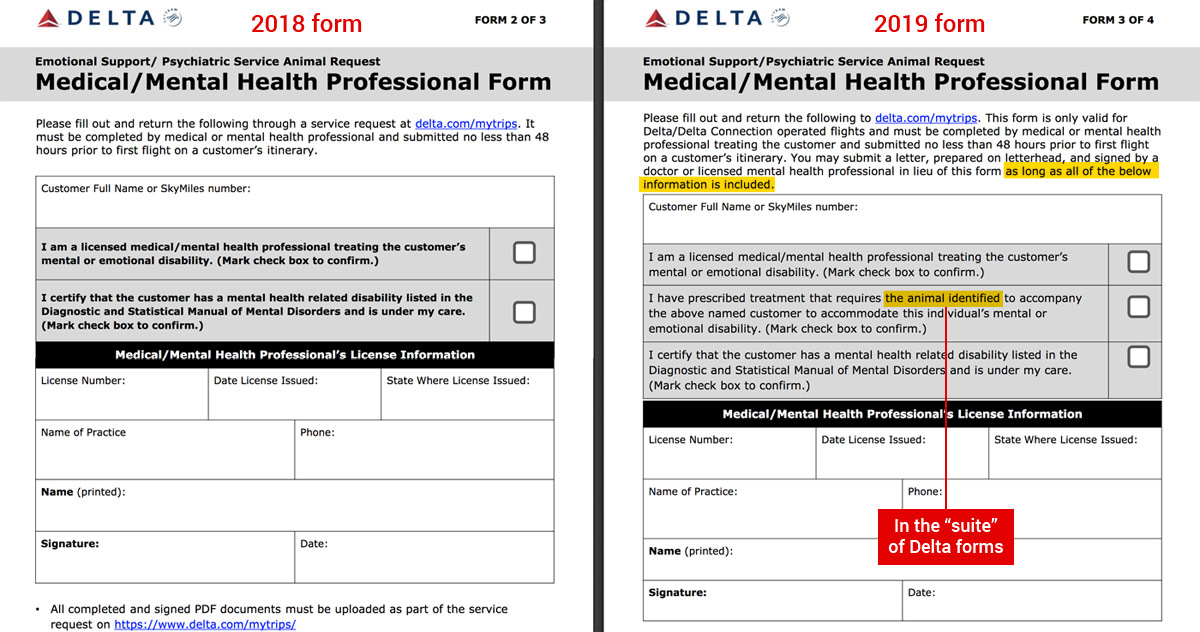
Delta might be concerned about these "letters" from mental health professionals too. Viewing Delta's 2018 vs. 2019 Medical/Mental Health Professional forms, one sees a critical difference. The new form requires the letter to "identify" the ESA or PSA accompanying the passenger. No longer can online letter mills be vague like in the Portland airport case, where the ESA letter only prescribed an "animal" for the owner, not even an animal type, much less the animal's name.

A Note About "Large" Dogs

After the attack, witness Bridget Maddox-Peoples estimated Mundy's dog weighed 50-pounds. Visual weight estimates of dogs are very difficult, even by police officers after a vicious attack. Some breeds, such as pit bull-types, have greater muscular density making them heavier than they appear too. Thus, it is unclear what the actual weight of Mundy's dog was. Some dog lovers will argue that 50-pounds is not "large," but it is large when the dog is sitting on your lap.

Labrador and golden retrievers, the most popular dog breeds in service work, average between 65 to 80-pounds for an adult male. Despite their size, well-trained service dogs curl up right beneath their partner's foot space or under the seat in front of them. Again, FAA regulations only allow lap-held service animals that are "no larger than a lap-held child," about 30-pounds or less. In the context of aircraft quarters, Mundy's dog was "large" and violated both FAA and Delta policies.

Summary

There appears to be little wiggle room for Delta by failing to abide by its own safety policies and procedures. As we noted in our July 2017 report, "Larger lap-held service animals may be a widespread practice too." Some airlines may not be re-accommodating these larger service and support animals to save money. We imagine those loose practices came to a resounding halt after Jackson was repeatedly attacked in the face by a large lap-held "psychiatric service animal."

A jury will determine whether Delta should have been requiring behavioral attestations prior to Jackson's attack and whether "the harm of large, untrained, and unrestrained animals in the cabin of an airplane was reasonably foreseeable to Delta." The loophole in the ACAA -- which favors "fakers" and frustrates airlines, who currently cannot ask for "certification of training" nor do they have a set of "clear standards" established by the DOT -- will also have to be examined by a jury.

What is undeniable is that Jackson suffered immensely during and after this vicious attack that pinned him against an airplane window -- he had no means of escape. "The area was completely covered in blood," witness Maddox-Peoples said. What is also undeniable is that Delta had a duty to enforce its own safety policies and procedures during the boarding process by requiring this larger-sized PSA to be stowed underseat or re-accommodated to a seat with more room.

"We are confident a jury of Mr. Jackson's peers will recognize the carelessness of Delta and Mr. Mundy and also appreciate the harm this needless danger caused Mr. Jackson," his attorneys provided in a statement to us. "Mr. Jackson is very appreciative of the encouragement received from so many air travelers, including those who regularly travel with service animals," added the statement. Our nonprofit prays Jackson is awarded all damages allowable under Georgia law.


Alexander Shunnarah & Associates have law offices in Alabama, Florida, Georgia, Mississippi and Tennessee. Attorneys J. Ross Massey and Graham Roberts represent Marlin Termaine Jackson.


Complaint against delta - Marlin Jackson injuries Delta

Marlin Jackson's injuries after being attacked in the face by a large dog onboard a Delta plane.

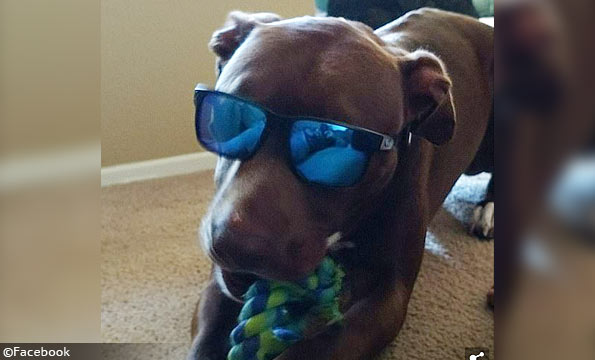
Complaint against delta - dog that attacked Marlin Jackson

Alleged "psychiatric service dog" that repeatedly attacked a man in the face on a Delta plane.

1Flight Standards Information Bulletin for Air Transportation (FSAT 04-01A), Order 8400.10 (July 23, 2004) and Guidance Concerning Service Animals in Air Transportation, DOT, May 3, 2003 (govinfo.gov)
2First, there is DOT Guidance (nonbinding) and DOT regulations (binding). Existing governing DOT regulations, 14 C.F.R. § 382.117 (e), do not preclude airlines from requiring behavior attestation forms for passengers with ESAs and PSAs to substantiate they will behave properly in the cabin. Delta began using attestation forms on March 1, 2018, stating they are "fully consistent with existing DOT's service animal regulations and Guidance." On May 23, 2018, DOT issued an Interim Statement of Enforcement Priorities (currently, DOT has not issued a final rulemaking). The interim statement spells out what DOT intends to enforce or not while the rulemaking process (Traveling by Air with Service Animals) is ongoing. The statement said in part: "Enforcement Office does not intend to use its limited resources to pursue enforcement action against airlines for requiring proof of a service animal's vaccination, training, or behavior for passengers seeking to travel with an ESA or PSA. At present, the Enforcement Office is not aware of any airline requesting information from ESA or PSA users that would make travel with those animals unduly burdensome or effectively impossible." So, as of May 23, 2018, Delta was officially in the clear to use behavioral attestation forms. However, we also know that on July 10, 2018, Delta banned all pit bull-type dogs as service and support animals, which some groups will argue is inconsistent with existing DOT's service animal regulations. Delta did not wait for a DOT enforcement (or Guidance) response for either the attestation form requirements or banning pit bulls as service and support animals. So, how Delta responds to the complaint -- if Delta could have been requiring attestation forms nine months earlier -- will be interesting.
3It is unknown if Mundy's dog had ever flown in an airplane cabin before. Early news reports stated that Mundy "advised [police] that the dog was issued to him for support," implying a military issued ESA or PSA. While writing our July 2017 special report, we found no online documentation confirming that any U.S. military branch "issued" ESAs or PSAs. In fact, we wrote a whole addendum on PSAs, which noted that in 2012, the Department of Veterans Affairs (VA) stopped funding PSAs because the agency is authorized to only pay for evidence-based therapies. From 2011 to 2018, the VA underwent a study of the benefits of PSAs that had to be revamped due to contracts being terminated due to bites and aggression. The results of that study are not yet available.
4Nondiscrimination on the Basis of Disability in Air Travel, 73 FR 27613, May 13, 2008 (govinfo.gov)

Related articles:
03/04/19: Mother of Child Mauled by an 'Emotional Support' Pit Bull at Portland Airport Sues
07/05/18: Why Breed Matters in Service Dogs and Why Pit Bull Service Dogs are a Bad Idea
06/23/18: Delta Bans Pit Bull-Type Dogs as Service, Support Animals in the Cabin
01/25/18: Delta Tightens Reins on Untrained 'Support' Dogs in the Aircraft Cabin
07/14/17: Delta Passenger is Severely Attacked by an Unrestrained Emotional Support Dog