


2008 Dog Bite Fatality: Tulsa Infant Killed by Labrador Puppy

mother of baby killed by dog
Linzy Earles, the mother of 2-month old boy mauled to death by family dog.

Manslaughter Charges archived
UPDATE 11/04/08: Linzy Earles, who turned 18-years old last month, has been charged with second-degree manslaughter in a juvenile court in connection with the mauling death of her baby, 2-month old Zane Alen Earles. The Tulsa police affidavit states that Zane "was left unattended in an infant swing on the opposite side of the house for approximately two hours." In this time, the family's 8-week old lab-mix,  "that was left loose in the house ate the two-month-old victim."

     Fransein’s order states that Earles was previously adjudicated as a delinquent child. A police affidavit states that Earles “has had a history of drug abuse and she was just taken off probation on June 2” in a drug-related matter.
Second-degree manslaughter involves an accusation of “culpable negligence” — an omission to do something that a reasonably careful person would do or failure to use ordinary care and caution.
“We feel that if not for her culpable negligence, it would have been prevented,” Cain said. - Bill Braun, Tulsa World, November 4, 2008

08/05/08: Neglect Charges Filed
A police affidavit alleges child neglect by the 17-year-old mother whose 2-month old son was mauled to death by a family pet. Tulsa Police allege that Linzy Earles has a history of drug abuse and was neglectful when her baby, Zane Earles, was killed by a dog at the home of his mother and grandparents on July 28. Police responded to a call about a dog mauling at the home. When officers arrived, they found the baby had been left unattended in a baby swing for about two hours.

     Investigators have been granted a warrant to test the mother's hair and take a blood sample to determine whether she was under the influence of alcohol or narcotics at the time of her son's death, and to possibly explain why "she was unable to wake up to hear her baby's screams prior to her baby's death,” according to an affidavit.
Police plan to conduct a decibel sound test in the home to find out whether any screams from the infant should have been heard when he was being attacked by the puppy, the affidavit states. Tests will be conducted inside the house to find any possible body fluids left at the scene by the puppy "tracked through the residence after eating the victim."- Johnny Johnson, The Oklahoman, August 6, 2008

07/30/08: Mother Only 17-Years Old
Authorities identified the 2-month old baby as Zane Alen Earles. Police have not released the names of his parents or his grandparents. Tulsa police spokesman Leland Ashley said the dog was taken to an animal shelter after the attack and euthanized. Ashley said the mother found her son dead in an infant swing about 10:30 am Monday. The child's body was taken to the state medical examiner's office, where the cause of death is pending, said Randy Saffell, a spokesman for the office.

      The child's father and grandfather left the home, 2904 E 102, at 8 and 8:30 a.m. Monday, Ashley said. Before the grandfather left, he put the infant in a swing in a dining room at the east end of the south Tulsa home. The infant's mother and grandmother were asleep in their bedrooms at the west end of the home.

Ashley declined to release the parents' names, but said the infant's father is 18 and the mother is 17.
Authorities think Earles was bitten numerous times by the black Labrador puppy. - Sheila Stogsdill, The Oklahoman, July 30, 2008

07/28/08: Baby Killed by Family Dog
Tulsa, OK - In a developing story, it appears another family dog has attacked and killed an infant. In this instance, the victim was a 2-month-old baby in Tulsa, Oklahoma. Police said the infant was mauled to death by a young Labrador this morning. The child died at the scene. Officer Jason Willingham says the baby's mother and grandmother were home at the time, but nobody was in the room when the attack occurred. He says the child was left in a swing.

Related stories:
07/25/08: 2008 Fatality: 1-Year Old Erie Girl Killed by Family Dog
07/23/08: 2008 Fatality: Mississippi 3-Year Old Boy Killed by Pit Bull


2008 Dog Bite Fatality: 1-Year Old Erie Girl Killed by Family Dog

Addison Sonney killed by family dog
Addison Sonney, 14-months old, was attacked and killed by her family's dog.

Family Dog Kills Child
Erie, PA - A 1-year-old girl has died after being attacked by her family dog. The Allegheny County medical examiner said Addison Sonney died yesterday at Children's Hospital of Pittsburgh. The girl's mother, Kari Sonney, was treated at a hospital for injuries suffered trying to save Addison. Police followed the dog into a nearby neighborhood and shot and killed it. The attack happened yesterday at the Laurel Hill Cemetery in Millcreek. The child's father is the cemetery caretaker.

The dog fled after the vicious attack. Millcreek police had to hunt the dog down with guns drawn. At first through dense thicket at the corner of Love and Zimmerly roads, where they shot it five times. The dog continued to flee, reports the Erie Times News, eventually into a wealthy nearby subdivision. Officers told children and people outside on the Sunday morning to go inside their home. The dog eventually took refuge on a porch on Cristina Drive, where police shot and killed it.

The dog, which police said was an old English sheepdog mix, was tracked down and shot dead by Millcreek officers.

Samples of the dog's remains have been sent to the state Department of Agriculture for rabies testing. Those results are expected today.

Addison was attacked at her family's home, the Laurel Hill Cemetery caretaker's cottage, 4523 Love Road, just after 10 a.m. Thursday. Her father, Brady Sonney, is the grounds supervisor at Laurel Hill, and the family lives in the cottage.

Addison's mother, Kari Sonney, also was injured in the attack. She was treated at Hamot Medical Center and released.

"She was trying to protect her daughter," Millcreek police Lt. Michael Tesore said of Kari Sonney.

Tesore said the two were in the home's living room when the attack occurred. He said investigators did not know what provoked the attack. - Kara Rhodes, Erie Times News, July 25, 2008

Related articles:
07/23/08: 2008 Fatality: Mississippi 3-Year Old Boy Killed by Pit Bull
06/19/08: 2008 Fatality: Boy Killed by Pit Bull in Weslaco, Texas

2008 Dog Bite Fatality: Mississippi 3-Year Old Boy Killed by Neighbor's Chained Pit Bull

killed by chained pit bull
Tony Evans Jr., 3-years old, was killed by his neighbor's chained pit bull.

Pit Bull Kills Child
Jackson, MS - A 3-year-old boy was killed Tuesday night in south Jackson after he was grabbed and mauled by a neighbor's chained pit bull. Tony Evans Jr was transported to the University of Mississippi Medical Center, where he was pronounced dead. No one else was injured in the attack. Police spokesman Sgt. Jeffery Scott said police had to shoot the animal in self-defense. The pit bull survived the shooting and was taken into custody by the animal control unit.

      Tony was last seen playing with a group of children across the street at the home of Shannon Reason. So, they knocked on his door to ask whether he'd seen the toddler.
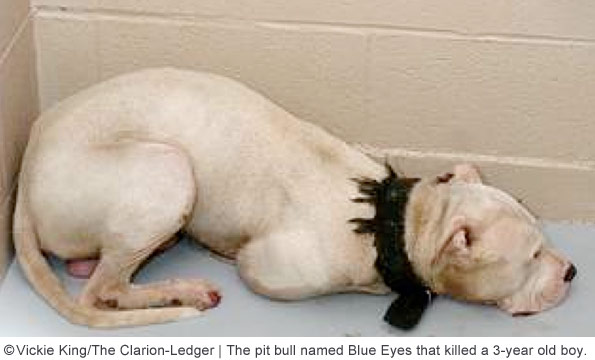
      He hadn't, but a while later Reason walked under his carport and made a chilling discovery: Tony's lifeless body next to his white male pit bull named Blue Eyes.
      The search ended in screams for help. But Tony Evans Jr., 3, was dead ...
      No one heard the attack. Police said the dog clamped down on Tony's neck and upper torso and dragged him inside a doghouse.
      When police responded Tuesday night, Blue Eyes charged them, causing officers to open fire. The dog survived and is under quarantine. The 2 1/2-year-old pit bull will be observed for 10 days before officials decide whether it should be euthanized. - Mark Bonner, Clarion-Ledger, July 24, 2008

During a news conference, Assistant Police Chief Gerald Jones said the owner of the dog didn’t violate any city ordinances because the dog was chained and confined to the property. Animal control will conduct an investigation to determine if
the dog is dangerous, he said. If the dog is designated as dangerous, the pit
bull can be euthanized or the owner will be required to follow stipulations in the city's dangerous dog ordinance, Jones said. Police continue to investigate.

pit bull blue eyes killed 3 year old boy

Related articles:
07/25/08: Mississippi Boy's Mother Discusses Fatal Dog Attack
07/23/08: 2008 Fatality: Mississippi 3-Year Old Boy Killed by Pit Bull
06/19/08: 2008 Fatality: Boy Killed by Pit Bull in Weslaco, Texas
05/19/08: 2008 Fatality: Boy Killed by Pit Bulls in Breckenridge, Texas

Service and Therapy Animals: Changes to the Americans with Disabilities Act (ADA)

Title II: Section 35.136 Service Animals
DogsBite.org - The Department of Justice is currently revising the Americans with Disabilities Act (ADA). Sections of the act that will be amended include service and therapy pets. Currently, there are no formal training standards to qualify an animal as a service or therapy pet. Many of the revisions the DOJ has made, however, are helpful, including the distinction that animals whose sole purpose is to provide "emotional support" are not service animals.

DogsBite.org is concerned about the growing effort of pit bull owners and other animal groups that advocate pit bulls as "excellent" service/therapy pets. We believe these groups may hoodwink disabled persons into believing that a pit bull is a safe dog. We are also concerned how the DOJ defines an "attack dog." In the Minimal Protection area the DOJ writes: "excluding from coverage so-called 'attack dogs.'" But what is an attack dog?

Does a dog have to attack once before it is labeled an attack dog? In many instances, a violent attack is a pit bull's first attack. Pit bulls were selectively bred to hide warning signals before an attack. The degree to which a person "does not know" whether or not a pit bull will attack is high enough to exclude the breed from all service animal work. Neither the community nor a disabled person can afford pit bulls being used in this area.

Back in January, two pet pit bulls attacked and killed one of their owners. The victim, Kelli Chapman was 24-years old. The family believes the dogs attacked her because she suffered a seizure while sleeping. The genetic traits of this dog do not make them a suitable service dog. The death of Kelly Chapman is a concrete example. Disabled individuals need dogs that can help them, not dogs that kill them while they are enduring a seizure.

Post Comment to DOJ
We highly urge you to post a comment directly to the Department of Justice about areas that concern you. To leave a comment, click the gold icon.

Definitions. Service animal means any dog or other common domestic animal individually trained to do work or perform tasks for the benefit of a qualified individual with a disability, including, but not limited to, guiding individuals who are blind or have low vision, alerting individuals who are deaf or hard of hearing to the presence of people or sounds, providing minimal protection or rescue work, pulling a wheelchair, fetching items, assisting an individual during a seizure, retrieving medicine or the telephone, providing physical support and assistance with balance and stability to individuals with mobility disabilities, and assisting individuals, including those with cognitive disabilities, with navigation. The term service animal includes individually trained animals that do work or perform tasks for the benefit of individuals with disabilities, including psychiatric, cognitive, and mental disabilities. The term service animal does not include wild animals (including nonhuman primates born in captivity), reptiles, rabbits, farm animals (including any breed of horse, miniature horse, pony, pig, or goat), ferrets, amphibians, and rodents. Animals whose sole function is to provide emotional support, comfort, therapy, companionship, therapeutic benefits, or to promote emotional well-being are not service animals.

Service animals. The Department wishes to clarify the obligations of public entities to accommodate individuals with disabilities who use service animals. The Department continues to receive a large number of complaints from individuals with service animals. It appears, therefore, that many covered entities are confused about their obligations under the ADA in this area. At the same time, some individuals with impairments -- who would not be covered as qualified individuals with disabilities -- are claiming that their animals are legitimate service animals, whether fraudulently or sincerely (albeit mistakenly), to gain access to the facilities of public entities. Another trend is the use of wild or exotic animals, many of which are untrained, as service animals. In order to clarify its position and avoid further misapplication of the ADA, the Department is proposing amendments to its regulation with regard to service animals.

Minimal protection. In the Department's ADA Business Brief on Service Animals, which was published in 2002, the Department interpreted the minimal protection language in its definition of service animals within the context of a seizure (i.e., alerting and protecting a person who is having a seizure). Although the Department received comments urging it to eliminate the phrase "providing minimal protection'' from its regulation, the Department continues to believe that the language serves the important function of excluding from coverage so-called "attack dogs'' that pose a direct threat to others.

Guidance on permissible service animals. The existing regulation implementing title III defines a "service animal'' as "any guide dog, signal dog, or other animal.'' At the time the regulation was promulgated, the Department believed that leaving the species selection up to the discretion of the individual with a disability was the best course of action. Due to the proliferation of animal types that have been used as "service animals,'' including wild animals, the Department believes that this area needs established parameters. Therefore, the Department is proposing to eliminate certain species from coverage under the ADA even if the other elements of the definition are satisfied.

Comfort animals vs. psychiatric service animals. Under the Department's present regulatory language, some individuals and entities have assumed that the requirement that service animals must be individually trained to do work or carry out tasks excluded all persons with mental disabilities from having service animals. Others have assumed that any person with a psychiatric condition whose pet provided comfort to him or her was covered by the ADA. The Department believes that psychiatric service animals that are trained to do work or perform a task (e.g., reminding its owner to take medicine) for persons whose disability is covered by the ADA are protected by the Department's present regulatory approach.

Proposed training standards. The Department has always required that service animals be individually trained to do work or perform tasks for the benefit of an individual with a disability, but has never imposed any type of formal training requirements or certification process. While some advocacy groups have urged the Department to modify its position, the Department does not believe that such a modification would serve the array of individuals with disabilities who use service animals.