

Jayce’s Law Has Hearing: Powerful Testimony by Charleston Humane Society and Mother of Boy Killed by Stray Pit Bull

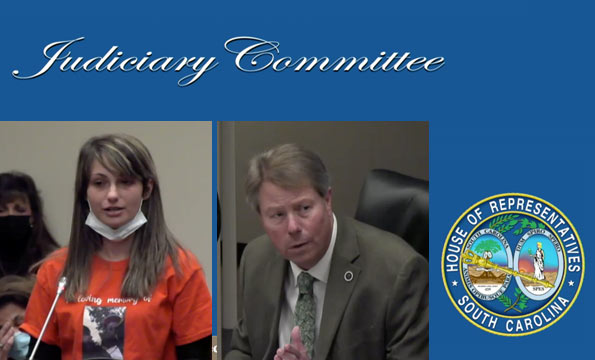
On April 22, 2021 a hearing was held for Jayce's Law, a proposed statewide pit bull law in South Carolina. Powerful testimony was given by his mother and the Charleston Animal Society.


Columbia, SC - On Thursday, "Jayce’s Law," H. 4094, sponsored by Rep. Huggins, had a hearing in the Special Laws Subcommittee of the House Judiciary Committee. It was a fantastic hearing with powerful testimony by Joe Elmore, president and CEO of the Charleston Animal Society, Jayce's mother, Victoria LaBar, Tallulah McGee, Director of Beaufort County Animal Services and Barbara Nelson, President of the SPCA Albrecht Center for Animal Welfare in Aiken County.

The hearing and this bill, the "fertile pit bull" bill, are both highly unusual events. Today, we saw a passionate Elmore, speaking on behalf of state animal sheltering organizations that support a breed-specific law. The bill would not affect any person whose pit bull is sterilized and microchipped -- the bill is not mandatory. Jayce's Law would charge a $25 fee to maintain a fertile pit bull that is not microchipped. For identification purposes, the microchip component is critical.

Emore testified about multiple fatal pit bull attacks, the death of Jayce in January and Ethel Horton, who was killed in Lee County in 2010. "This affects men, women, children, black, white, elderly. It affects all of us South Carolinians. It affects our families," he said. "The most pressing issue for animal shelters, in costing millions of dollars each year, taxpayer dollars and donor dollars, is the disproportionately large number of pit bull-type dogs" that are not altered.

Elmore brought compelling state animal shelter data to the table during his testimony. (Note also, this 2021 peer-reviewed study where Charleston Animal Society provided the animal data: Characterizing unsuccessful animal adoptions: age and breed predict the likelihood of return, reasons for return and post-return outcomes). Elmore also expressed how much support the bill has among South Carolina shelters, "those of us working on the front lines" in this state, he said.

These are the facts. These are South Carolina facts. This is South Carolina data. Pit bull-type dogs are the most prevalent dogs entering South Carolina shelters ... Right now at our shelter in Charleston County, we have 98 dogs in our care, 38 of those are pit bull-types of dogs, 42%. That is not uncommon...

Number two, pit bull-type dogs are disproportionately euthanized due to the overwhelming numbers of them ... [local shelter data] indicated that nearly half of the types of dogs put down were pit bull-types of dogs.

Pit bull-type dogs are the exclusive dog of choice for dogfighting.

Pit bull-types of dogs cause more severe injuries to South Carolinians than any other dog. This is from our DHEC, our South Carolina DHEC. In 2019, 34% -- 2,533 of the 7,455 identified breeds of dogs committing bites, were from pit bull-types of dogs...1

This legislation addresses four problems. Incentivizing spay/neuter. Relieving significant burdens on animal shelters. Reducing the number of dogs available to dogfighting. Mitigating the amount of harm caused to humans by fertile pit bull types of dogs and raising awareness about the plight of these dogs…

For the sake of our sons of South Carolina. For the sake of our grandmothers of South Carolina, let us not go another ten years without action." - Joe Elmore

As Elmore states in his testimony, the only groups that oppose the bill are out-of-state -- the same groups we deal with every year when fighting state preemption bills that would prohibit local pit bull ordinances. The Big Three: American Kennel Club (AKC) and Animal Farm Foundation, both New York-based and Best Friends Animal Society, Utah-based. Notably, it was brought up several times during testimony that this national kennel club does not even recognize the pit bull breed.

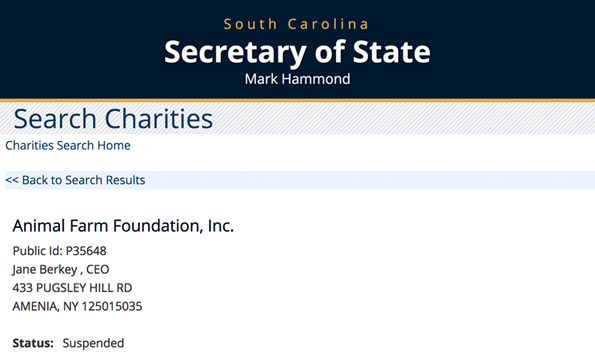
Elmore also stated the following, of which we may hear about more down the road: "The Animal Farm Foundation is suspended in South Carolina. Today, it is suspended by our Secretary of Commerce. I see no standing for these three organizations," he said. "The AKC does not even recognize pit bulls as a breed of dog, doesn't run animal shelters, neither does the Animal Farm Foundation." He added about BFAS, "I couldn't even tell you what states surround Utah."

"I couldn't even tell you what states surround Utah. I don't think most South Carolinians could. I don't think most South Carolinians care."

Elmore's testimony and emphasis on "our DHEC" and "our South Carolina DHEC" and "our sons of South Carolina" and "our grandmothers of South Carolina" shows just how much interference the Big Three had on the failed attempt at a similar bill in 2019 -- that bill had a $500 registration fee. Despite the exceptionally modest $25 fee, the Big Three are still hard at work to kill Jayce's Law. The Big Three's "hatred" of breed-specific laws outweighs the well-being of pit bulls.

Jayce's Mother

Victoria's livestream to Facebook after her son's death was breathtaking. Her testimony today was breathtaking as well. She is only 23-years old, and she is as brave as they come. She tells her story of the stray pit bull that ended up on her property that was not fixed. She contacted animal control, but the pit bull was not microchipped. "The bottom line is, a phone call could have saved my son's life. If whoever owned that dog had just called and reported him missing," she said.

"In less than three seconds, my life changed. Eight days the dog was with us. He showed no signs of anything. Until he just walked up to my son and ripped out his throat," she said. "If these laws had been in effect, just maybe my son would be alive today. Nothing will bring my son back. My son and a dog died that day, and neither one had to happen ... I had found [the dog] a home. The day the man was supposed to come get him" is the day the dog killed my son, she said.

"We still have no idea who the dog belongs too. We can find no vet records for his rabies vaccines. He had no microchip. He was not fixed."

McGee & Nelson

McGee testified about the mandatory pit bull sterilization ordinance her county passed in 2015 and the success of this ordinance. This success was also possible because the Hilton Head Humane Society provided free pit bull spaying and neutering services. Like San Francisco, which passed the first mandatory pit bull sterilization ordinance in the country in 2005, McGee's shelter used a Fix-It-or-Ticket campaign (administrative tickets) to support the enforcement of the ordinance.

McGee testified that higher penalties should come to those creating the problem. The time and effort required to collect a $25 fee would not be cost effective, she said, but the bill is a step in the right direction. We hope in the future, "we need to be aggressive and hope that administrative tickets would be in enforcement throughout the state. Because the revenue to pay for free sterilization would be from the people who are the problem, not the taxpayers," McGee testified.

Like Elmore, Nelson expressed that her SPCA is "local and on the ground" and is not associated to the New York-based ASPCA. She also reiterated that pit bulls have "historically been bred to have extremely strong jaws and do not let go of their victim. They are the breed of choice for drug dealers, and others who post them as alarms in protection against law enforcement. They have found their way into the general population of dogs, and that is extremely unfortunate." she said.

"They are the most abused. They are the hardest to adopt and the most euthanized. They are by far the largest percentage of dogs in shelters."

Nelson also testified about the success of her registration fee ordinance, despite the AKC's opposition. "The AKC, a national organization that does not even recognize the breed of pit bulls, opposed that ordinance," she said. The Aiken ordinance charges $100 to register a fertile dog; it's a lifetime fee. "It worked extremely well," she said. "Registration ordinances for fertile dogs work." In 15 years, she has seen a two-thirds reduction of unaltered dogs brought into her shelter.

"We had no push back from the citizens," she said. "The only push back we had was from AKC. They told me it wouldn't work. They told city council it wouldn't work. Fortunately, city council was progressive enough. They passed the ordinance. You can see that it worked," she said. "Understand that these dogs have the propensity to turn like that if they are fertile -- they have a tendency to be aggressive. I will be happy to answer any of your questions," she said.

Summary

The Big Three oppose all breed-specific policies and laws and are the top forces working in our country to 1.) Repeal local pit bull ordinances 2.) Pass state preemption laws barring local governments from enacting and enforcing pit bull laws 3.) Pass laws that prohibit property insurance carriers from using breed-specific policies (the breed "blacklist") and 4.) Pass laws that prohibit landlords and public housing authorities (Section 8) from using breed-specific policies.

Elmore and his South Carolina animal welfare colleagues have done the unthinkable in the eyes of the Big Three. They have fragmented the once all-powerful alliance of animal welfare groups opposing breed-specific laws. Elmore and his colleagues did so because they want to create a safer community for people and to provide a humane solution to the excessive over-breeding of pit bulls. They have mounted a strong force against the Big Three and we wish them success!

As Elmore implied, if the state had taken these steps -- a bill like Jayce's Law -- ten years ago, shelters in South Carolina would not be experiencing the safety and humane crisis of pit bulls disproportionately biting, occupying shelter space and being euthanized. The Big Three out-of-staters have no care in the world about shelters in South Carolina brimming with unwanted pit bulls. They have no care in the world for the sons or grandmothers of South Carolina either.
Jayce's Law South Carolina

On April 22, a hearing was held for Jayce's Law, the "fertile pit bull" bill in South Carolina.
Jayce's Law, pit bull south carolina

New York-based pit bull group, Animal Farm Foundation, was suspended in South Carolina.

1DHEC is the South Carolina Department of Health and Environmental Control.

Related articles:
04/12/21: South Carolina 'Fertile Pit Bull' Bill has Support from Animal Shelters Across the State
02/02/21: Estimated U.S. Cities, Counties, States and Military Housing with Breed-Specific Laws
01/22/21: 2021 Dog Bite Fatality: Mother Live Streams After Pit Bull Killed Son in South Carolina
Unprovoked Pit Bull Attack in Maine Shows that Characteristics of 'Classic Pit Bull Attack' Violence Never Change

"Tell them to step it up. Tell them to step it up!" - Audio Dispatch Files

classic pit bull attack maine
Pit bull attack in Maine shows that "classic pit bull attack" traits never change.

Classic Pit Bull Attack
Lewiston, ME - On Thursday morning, a 71-year old woman was viciously attacked by a loose pit bull while she raked leaves in her own yard. The dog was still actively attacking the woman when police arrived. The first officer on scene said the woman was yelling, "He (the dog) is killing me." The officer Tased the pit bull, which "momentarily" stopped the attack. The pit bull then returned to biting the woman on her face and neck. The officer then shot and killed the attacking pit bull.

After being shot by a firearm, the pit bull was still able to bite the woman one last time before running a short distance and finally dying.

Paramedics rendered medical aid and transported the victim to Central Maine Medical Center in Lewiston where she is currently being treated for injuries to both arms, leg, neck and face. About 2:30 p.m., a relative told the Sun Journal that the woman was undergoing surgery to repair extensive damage to both her arms, her thighs and her face. She described the attack as a "mauling." It is believed the dog broke through a damaged section of a fence to attack the woman.

Audio dispatch files from Lewiston Fire and EMS are chilling. Dispatcher states, "Female actively being attacked by a pit bull." Three minutes later, "Dog is still attacking her. Female's arm and hands are injured. Just won't let go." Then a male voice states, "Tell them to step it up. Tell them to step it up!" Dispatcher tells police, "Can you step it up? United is on scene. Dog still attached to her arm. Won't let go." Finally, a man states, "Dog's been shot. Victim is pretty bad off here."

Listen to the chilling truncated audio dispatch file from Lewiston Fire and EMS.

Elements of a Classic Pit Bull Attack

  • Unprovoked attack off its owner's property.
  • A sustained attack lasting 10 minutes or longer.
  • A tenacious, relentless, repeated attack that cannot be stopped through normal means.
  • Non-lethal human intervention fails. Police said witnesses tried to get the dog to release its grip on the woman’s arm.
  • Non-lethal Taser fire fails. The Taser only stopped the attack "momentarily" and the dog went right back to biting.
  • Lethal firearm intervention stops the attack, but after being shot and before dying, the pit bull was still able to bite the woman one last time.

Pit Bulls also possess the quality of gameness, which is not a totally clear concept, but which can be described as the propensity to catch and maul an attacked victim unrelentingly until death occurs, or as the continuing tenacity and tendency to attack repeatedly for the purpose of killing. It is clear that the unquantifiable, unpredictable aggressiveness and gameness of Pit Bulls make them uniquely dangerous.

Pit Bulls have the following distinctive behavioral characteristics: a) grasping strength, b) climbing and hanging ability, c) weight pulling ability, d) a history of frenzy, which is the trait of unusual relentless ferocity or the extreme concentration on fighting and attacking, e) a history of catching, fighting, and killing instinct, f) the ability to be extremely destructive and aggressive, g) highly tolerant of pain, h) great biting strength, i) undying tenacity and courage and they are highly unpredictable. - Vanater v. Village of South Point (1989)

The 1989 ruling shows that the characteristics of a pit bull attack do not change over time. This is why over 1,000 jurisdictions in the US still regulate the breed. This is why jurisdictions in at least 54 countries worldwide have breed safety laws regulating pit bulls. In 43 of those countries, the regulation is a national-level law. During Wave 1 of state preemption bills, the state of Maine preempted breed-specific laws in 1991, barring local governments from adopting pit bull laws.

The Pit Bull Owner

Lewiston police identified the owner as 35-year old David Davis of 12 Myrtle Street. Davis was charged with "Keeping a Dangerous Dog, Failing to license and vaccinate a dog and allowing a dog to run at large," according to police. These are all low level crimes (only one is a Class D fine under Maine law).1 Davis is scheduled to answer to those charges at Lewiston District Court on August 11, 2021 -- about 3.5 months later than any other state would schedule this hearing!


Press release from LPD: PRESS RELEASE FOR IMMEDIATE RELEASE
CONTACT: Thursday, April 15, 2021 at 4 pm
Lieutenant David St.Pierre
(207) 513-3001 ext. 3323

At approximately 11:14 am on this date, the Lewiston Police Department responded to a frantic call for assistance at 34 Helen Street. The caller reported a 71 year old woman was "being attacked by a pit bull." The caller further reported the dog was "attached to the elderly female." Reports and updates continued to come in as officers responded to the scene and were updated. The information indicated the woman was on the ground being mauled by the dog and her arm and hand was severely injured. The woman reportedly lost consciousness prior to the officer's arrival as the dog continued its attack.

Upon arriving, a Lewiston police officer took quick action when he observed the dog continuing to aggressively bite the women and noting the woman; laying on the ground screaming for help, had sustained significant, evident injuries to her arm. The woman was clearly in distress and was yelling, "he (the dog) is killing me." The officer tased the animal which momentarily stopped the attack on the woman. The dog then attempted to bite the officer and then turned its attention back to the woman; biting her on the face and neck. The officer; fearing that this bite would result in fatal injuries to the woman, shot the dog once with his handgun in the side. Despite being shot, the dog was able to bite the woman one last time before running a short distance where it died.

Paramedics were on scene and rendered medical assistance and transported the victim to Central Maine Medical Center in Lewiston where she is currently being treated for injuries to both arms, leg, neck and face. This attacked appears to be not provoked as the woman was out raking in and around her yard. Our animal control officer also responded to the scene and is involved in this on-going investigation. The animal will be transported to Augusta for rabies testing.
The dog owner has been identified as 35 year old David Davis, of 12 Myrtle St in Lewiston. At this time, we have charged Davis with Keeping a Dangerous Dog, Failing to license and vaccinate a dog and allowing a dog to run at large. He is scheduled to answer to those charges at Lewiston District Court on August 11, 2021. There is a possibility for additional charges to be filed at the conclusion of the investigation.

1 Class D: Crimes punishable by up to 364 days incarceration and a $2,000 fine.

Related articles:
02/02/21: Estimated U.S. Jurisdictions with Breed-Specific Laws (2020-2021)
06/24/15: The Mechanics of a "Classic" Unprovoked Pit Bull Attack - Alaska
05/20/15: A Primer on State Preemption Laws and Charts for Advocates
05/05/09: Alexandra Semyonova: Heritability of Behavior in the Abnormally Aggressive Dog

Animal Advocate Posts Video After Adopted Out Pit Bull-Mix Viciously Attacked a Carriage Horse in Cane Creek Park

On April 3, Amanda Underwood and Queen Charlotte, a draft horse, were severely injured after a pit bull-mix broke free and attacked the horse while it pulled a carriage in Cane Creek Park.


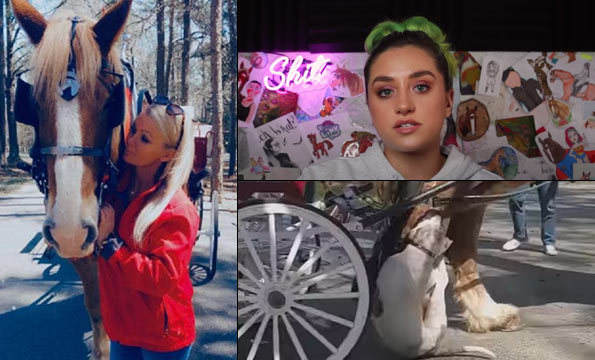
Union County, NC - On April 3, pit bull-mix violently attacked a draft horse pulling a carriage in Cane Creek Park as children screamed in the background. The carriage driver, Amanda Underwood, was seriously injured while trying to fend off the attack. The draft horse, Queen Charlotte, was also badly injured by the dog. A cell phone video captured part of the attack, where one sees the dog repeatedly attacking the horse, until Queen Charlotte delivers a ruinous kick.

After the attack, Amanda's brother spoke to Fox 46. "It was bad. I mean it was horrific," said Travis Medlin. "The dog jumped up an actually latched onto the horse's throat ... the horse trampled my sister four different times throughout that event. Each time, she just came back and continued to fight the dog, was trying to save the horse." She suffered multiple head wounds and a broken foot that will require surgery, Medlin said. Hospital bills are expected to cost at least $25,000.

"My sister is the blonde in the red shirt. This video only captures the end of what happened. The attack lasted a distance of 200 yards. My sister was driving the carriage when the pit attacked and latched onto the horse's neck. She handed the reins to her assistant and jumped down and threw the dog off. This repeated many times. My sister fought with the dog under the horse and in the process was trampled by the horse 4 different times. She went to the hospital and has 4 hematomas on her head from being kicked by the horse. Had to have the back of her head staples, a broken foot, horse shoe shaped bruises all over, swollen knee that will need an MRI and is so sore she cant get out of bed. With all that, you see her still standing by the horse at the end of the attack like the bad ass she is. If not for her actions things would have turned out much worse for everyone involved.

As for the horse, it has 15 bite wounds on its neck and legs, multiple bites to its face and its lips were shredded, but it's doing ok.

The dog was put down by the vet due to its injuries." - Travis Medlin YouTube comment

Since the attack, multiple events have occurred. On April 12, RaleighLink14, who is a horse owner and an animal activist, published a video commentary featuring parts of the Fifth Estate documentary (Pit Bulls Unleashed: Should They Be Banned?) and the Cane Creek Park attack under the title, "Why I No Longer Support Pit Bull Ownership." Her video is the subject of this post. On April 13, we learned that CMPD Animal Care and Control adopted out the dog in 2019.

At the time, CMPD noted that the dog had a "tendency to pull on the leash but he will slow down with gentle pressure." The dog was vaccinated and a health check did not indicate there was any behavior problems, CMPD said.

The dog was adopted in 2019 at an event at South Park Mall. A person who fostered the dog noted that it was "friendly with people and children, loves walks and car rides" but "will pull after cats on his walk." - MyFox8, April 13, 2021

RaleighLink14's video is powerful and self-explanatory. She admits that she will be attacked by pit bull advocates for making the video and admits she was previously an advocate for the breed. "I'm just not anymore," she states. "I can't sit back in good conscience and continue to support the ownership of pit bulls." She later adds, "Someone needs to fucking start speaking out about this. And I know I'm kind of the lone wolf right now, and I'm probably going to be crucified for this..."

Other themes include: While working at a shelter, many pit bulls failed behavior tests and were not safe to adopt out; she had to euthanize a number of pit bulls; she also goes as far to say that pit bulls should be banned, and she asks the glaringly obvious question, "Should everybody be able to own a pit bull? No." She then covers statistical data that our nonprofit has been publishing about for 10 years. The difference being, it's her voice stating it to other animal advocates.

In addition to going against the grain of pit bull advocates, she definitively states that some pit bulls must be euthanized for behavior as well, toppling the Holy Grail of no-kill advocates. That is just two more badges of courage for Raleigh. "I used to think all of the pit bull bans were bullshit," she said, "but if you really look into the statistics, and you really talk to doctors who experience this stuff ... and then you yourself have your own personal encounter ... you start to understand."

Sanctuary Solution?

Raleigh, however, goes astray significantly toward the end, when she proposes, "sanctuaries should be put in place for pit bulls." Where they "can be rehabbed and live a normal life there." Our nonprofit has written extensively about this fantasy. Pit bull sanctuary after pit bull sanctuary has resulted in fraud, hoarding operations and animal cruelty over the years, including: Spindletop (TX), Olympic Animal Sanctuary (WA) and most recently, The Steffen Baldwin Center (CA).

Baldwin was already headed down a path of doom: a "sanctuary operation" of "reactive" dogs with bite histories. - DogsBite.org, August 18, 2020

Pit bulls that wind up at these places often have impulsive aggression, dog aggression and more. They cannot be rehabbed for living in a normal society. These "sanctuaries" are often little more than each pit bull fenced-off in a small yard alone or kenneled alone. Frankly, these sanctuaries aren't too different than a dog fighter's yard, and in some cases (Spindletop and Olympic Animal Sanctuary) their living conditions are worse, thus the hoarding and animal cruelty charges.

YouTube Comments

There are nearly 6,000 comments. Common themes include: Not everyone should own a pit bull; the more I educate myself, the more I see the merits of bans; there is a large community of others who feel the same way you do; my mind has been changed dramatically; Raleigh has guts for posting this video; and finally, "How could I argue with those statistics?" Our answer: The same way many people like you have been doing for years, by claiming that our statistics are false.


Umm -- I totally understand where everyone is coming from. But, unless we can stop bad owners from getting dog.. unfortunately for the safety of everybody, including dogs themselves, i believe that only professionals should own Pitt Bulls. They will spend the rest of their lives in shelters and honestly that’s just heartbreaking...

Charlie -- I respect Raleigh for having the guts to post this, as she's almost certainly going to have some of her followers turn on her after they merely see the title of her video...

Vero -- I've been pro pittie for a long time saying it's the owners fault. But the more I educate myself, the more I see that there is merit to the fears and bans of pit bulls ... I think the problem is ultimately both owner and breed...

Fluffies -- I hate that I have to agree with this but you're hitting the nail on the head.

Rebeka -- Thank you for making this video, I personally have supported pit bulls as a breed and believe the "it's the owners not the dog" mantra. This video educated me on the facts, and although it's an uncomfortable topic, I believe it's important to be able to change your opinion when new information is presented...1

Mary-Beth -- This is actually very interesting to me! Up until this moment i have also said "it's not the dog it's the owner". And I just assumed the majority of the people that owned Pit Bulls were the snobby rich people that think having a pit bull was cool and trendy. But how can I argue with those statistics?

Amelia - I own 4 pit bulls. They all are saved from being put down. Anywhere we go we muzzle them not for my dogs safety but kids and other dogs. I believe not everyone should own a pit bull. They are literally wild animals I swear. I own horses and my dogs are not allowed near them. But I agree with you Raleigh...

Rene -- Thank you for making this video. I know there are a lot of advocates for pit bulls and you are ridiculed for even speaking against pits. But just know there is a larger community of people who feel the same way you do. Most have had horrific run ins with these dogs in one way or another...

Elisha -- Its such a tough subject. I use to work at a facility in Jacksonville Fl and our soul purpose was to rehab pits that had been used in the fighting culture. I use to be a HUGE advocate for the breed ... My mind has been changed dramatically the pet couple of years. I still love the breed and I always will. But they are not a good family pet...

Ayanna --The general problem is, that many people underestimate the (genetic) potential of their dogs and the specific training these potentials require. No matter if it is a hunting dog, a herding dog or a dog like a pit bull. Unfortunately, the latter can become incredibly dangerous and since you cannot make sure, that not every - sorry - idiot gets such a dog, there should be some kind of regulation.

Kate -- I used to be an advocate for pit bulls, but once I became a dog owner myself I changed my viewpoints. Every. Single. Time. My dog had been attacked it was by a pit bull. The worst one that happened the owner literally stated to me "he’s been acting like this lately" and he still brought him into a dog park unleashed and with no muzzle...

Sixty-two -- I used to believe pit bulls shouldn't be banned because they were just dogs. I thought it was always the owners fault and only theirs. After watching this video I'm seeing things in a new light and all so much more serious than i initially thought it was.


Summary

The violent attack on Queen Charlotte at Cane Creek Park while children screamed in the background has caused a tremendous outpouring from the public and animal advocates. Raleigh may as well have plucked language directly from appellate court rulings in her description of a relentless pit bull attack. "This dog kept coming back over and over and over again ... These dogs will not stop once they find a victim. It is nearly impossible to get a pit bull off of the victim."

The discussion Raleigh has about shelters adopting these dogs out to the public, who in many cases "can't handle" the dog, is well argued. However, news that this dog was adopted out by the CMP Animal Care and Control in 2019, would had added even more fuel to her fire. That shelter, indeed, adopted this dog out to an owner who couldn't control the dog. Notably, the shelter stated it was an American bulldog. Though, it appeared to us and others to be an overweight pit bull-mix.

Finally, the fact that Raleigh is making these statements to her audience of animal advocates, makes all the difference in the world doesn't it? Animals 24-7 is an animal advocacy nonprofit, but faces nearly the same wrath by pit bull owners and no-kill advocates as our nonprofit does. What gives? Both nonprofits are on the front line of collecting data in the area of serious and fatal dog attacks by breed since our government will not. Data that shines a light on dangerous breeds.

Cane Creek Park horse attack

On April 3, an adopted out pit bull-mix viciously attacked a draft horse in Cane Creek Park.

1New information? Well, better late than never!

Related articles:
01/04/21: Working at an Open Intake Shelter: Deliberate Breed Mislabeling, Aggressive Dogs...
12/16/20: Ann Marie Rogers: Animal Welfare Advocate, Animal Control Officer, Public Safety...
08/18/20: How a Pit Bull Activist Rose to Fame in the No-Kill Community While Killing Dogs
10/16/19: A Pit Bull Adoption Disaster: Animal Aggression, Anti-Anxiety Medication, Ceasing...

South Carolina 'Fertile Pit Bull' Bill is Back with Lower Fees and Support from Animal Shelters Across the State

fertile pit bull bill
The "fertile pit bull" bill has been reintroduced in South Carolina with lower fees.

Reducing Pit Bull Births
Columbia, SC - Last week, it was reported that House Bill 4094 was filed by Rep. Chip Huggins. The “fertile pit bull” bill only affects pit bulls that are not spayed or neutered in the state. If an owner chooses to keep an unaltered pit bull, the registration fee is only $25. Similar legislation introduced in 2019 required a $500 fee. The new fee reduces the incentive to sterilize, but at least there would be language in the state code that recognizes the uninhibited breeding of pit bulls.

Pit bulls "account for a disproportionate number of dogs both entering shelters and euthanized at an even higher rate in shelters," said Joe Elmore, president and CEO of the Charleston Animal Society. "It's simple supply and demand -- there are far too many [pit bulls] then there are homes. It's costing taxpayers and donors millions of dollars each year." Taxpayers have long footed the bill for housing unwanted pit bulls in public shelters, but as Elmore states, donors are paying too.

Huggins' bill is called “Jayce's Law," in honor of a boy killed in January by a stray pit bull his mother had recently taken in. His grieving mother live streamed on Facebook afterward, "My 6-year old little boy was attacked early this afternoon by the pit bull that I had been trying to find a home for. It had been abandoned on our property." She added, "I was an advocate, supporter for pit bulls. What happened, happened so fast that there was nothing that anybody could do."

State-Level Data

Included in the article is rare state-level dog bite data by breed. In 14 years, we have only come across one other state, Delaware, which has centralized bite reporting that includes breed data. The South Carolina Department of Health and Environmental Control released the data. In 2019, there were 7,499 bites from known breeds. Of those, one-third, (2,433 bites), were inflicted by pit bulls and their mixes, three times more than the next top-biting breed, Labradors with 833 bites.

Unlike the 2019 bill, which sat untouched in the House Committee on Agriculture, Natural Resources and Environmental Affairs, House Bill 4094 was sent to the House Judiciary Committee. Huggins said he hopes the bill can pass the House this year and be sent to the Senate for consideration next year. As one would expect, pit bull owners and out-of-state lobby groups strongly opposed the 2019 bill. As a result, the $500 bill never even had a hearing.

While trying to defend the 2019 bill, Elmore penned a bold piece titled, "Endangered Species?" He wrote, in part, "No other dog breed or grouping of breeds poses the overcrowding problem for animal shelters as does pit bull type of dogs. It is critically important to distinguish this strategy as reducing the overpopulation, not advocating for a breed ban, which we all vehemently oppose." However, pit bull owners and defenders of the breed rarely listen to logical humane arguments.

"A mandatory pit bull sterilization law is the most basic safety step a community can take when pit bulls are disproportionally biting, disproportionally occupying shelter space and disproportionately being euthanized. This is the right side of the issue to be on." - DogsBite.org, October 24, 2019

Elmore also pointed out that mandatory pit bull spaying and neutering laws are already working in jurisdictions in South Carolina and across the country. Beaufort County, South Carolina enacted the first mandatory pit bull sterilization law in the state and shortly thereafter saw excellent results. After the ordinance passed in October 2015, the pit bull sterilization rate more than doubled in just 14 months. Jurisdictions in California and Michigan have seen similar successful results.

Lowest Sterilization Rate

Back in January, we published a letter from a person who previously worked at an open intake shelter who stated, "pit bull breeders seem to be less responsible with spaying and neutering their dogs." This has also been documented in a peer-reviewed study. A 2011 study examining the prevalence of castrations evaluated at US veterinary hospitals found the overall castration rate of dogs was 64% and pit bulls (27%) were the least likely of all dogs breeds to be castrated.

This is not a new problem, nor is it an unknown problem. Animals 24-7 has been reporting on the low sterilization rate of pit bulls for many years. Staff members of shelters and humane groups, who see intake dogs on a regular basis, know this. Pit bull rescues know this. As the 2011 study shows, employees at veterinary hospitals also know this. Yet, most shelters, humane groups, pit bull rescues and veterinarians strongly oppose mandatory pit bull sterilization laws.

The solution to this opposition, according to Elmore and Rep. Huggins, is to lower the cost of registering a fertile pit bull to $25, the cost of "one cheap bag of dog food," Elmore said. It seems a fee of $75 would send a much stronger message, certainly a fee of $150 would. State legislation is often a "baby steps" phenomenon. Likewise, it's better to have the pit bull problem codified into law than not. Expecting significant results from the $25 law, however, may be wishful thinking.

More Wishful Thinking

Speaking of wishful thinking and recent legislative news, a top lobbyist for Best Friends Animal Society, Ledy Vankavage, recently showed her complete failure of due diligence regarding the National Defense Authorization Act (NDAA). It's either failure of due diligence on her part or cultivating a lie. She's certainly capable of both. She falsely claimed on March 22 and April 1 that the NDAA signed into law by President Trump contained a "breed neutral" mandate.

On March 22, Ledy Vankavage, a lobbyist for Best Friends Animal Society, falsely claimed to Bruce Dickey that the National Defense Authorization Act (NDAA) 2020-2021 forced the Department of Defense to eliminate long standing breed-specific polices within military divisions. The U.S. Army, U.S. Marine Corps and U.S. Air Force have banned a small group of dangerous dog breeds from military housing—chiefly pit bulls, rottweilers and wolf-dog hybrids—for over a decade.

The final language of the reconciled NDAA that President Trump signed into law did not contain a “breed-neutral” mandate. Clearly, Vankavage, a top paid lobbyist for pit bull causes, never bothered to read the reconciled version of the Act. This is a failure of due diligence on her part. The removal of the “breed-neutral” mandate was in part due to advocacy by Responsible Citizens for Public Safety (RC4PS.org) and DogsBite.org. - DogsBite.org, March 22, 2021

Watch part of the March 22 interview where Vankavage makes the false claim on the Big Talk with Bruce Dickey show, and again on April 1, when she makes the false claim in the "unlisted" Best Friends Grassroots Advocacy video. Advocates for dog bite victims left comments on the latter video, stating that the breed neutral mandate was not signed into law and that Vankavage had failed to even read the reconciled version of the NDAA -- those comments have been deleted.

The part about U.S. Senator Duckworth (Illinois-D) sending a "demand letter" to the Department of Defense is the most amusing part. Vankavage has little congressional legislation experience (chiefly local and state), if she did, she would have understood that many changes are made during the reconciliation process. Until the NDAA 2020-2021, this nonprofit had little congressional legislation experience either, but we knew that monitoring the reconciliation process was critical.

Related articles:
01/22/21: 2021 Dog Bite Fatality: Mother Live Streams After Pit Bull Killed Son in South Carolina

01/04/21: Working at an Open Intake Shelter: Deliberate Breed Mislabeling, Aggressive Dogs...
10/03/20: 2020 Dog Bite Fatality: 32-Year Old Woman Mauled to Death by Dogs in South Carolina